About Neottia banksiana (Lindl.) Rchb.f.
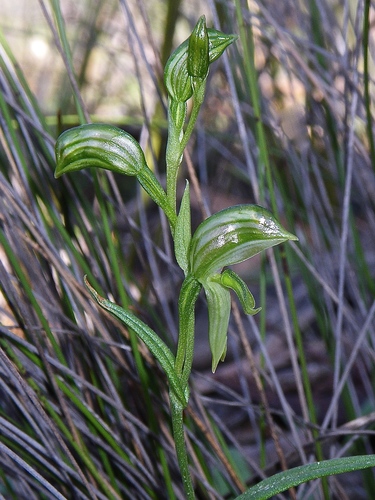
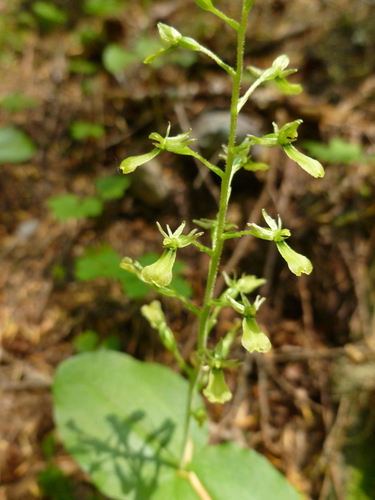
Neottia banksiana (Lindl.) Rchb.f. is an orchid species commonly called northwestern twayblade. This species was previously classified in the genus Listera, but molecular phylogenetic research demonstrated that Neottia nidus-avis, the bird's-nest orchid, evolved within the clade that once held only Listera species. As a result, all former Listera species have been formally reclassified into Neottia, the older, priority genus. Some authorities and sources still use this species' former genus placement, and its older valid scientific names include Listera banksiana and Listera caurina. This orchid is native to northwestern North America, ranging from Alaska through the Pacific Northwest, extending south to Mendocino County, California and east to the Grand Teton Range of Wyoming. It grows in moist, shaded habitats, most commonly in the understory of mountain forests. Neottia banksiana is a rhizomatous perennial herb that grows an erect stem 10 to 30 centimetres (4 to 12 inches) tall. It produces one pair of oval-shaped green leaves near the base of the stem; each leaf can reach up to 7 centimetres (3 inches) in length. Its inflorescence is a small raceme bearing green or yellow-green flowers. Each flower typically has 3 lance-shaped sepals, 2 similarly shaped petals, and one specialized petal called the lip, which is longer than the other floral structures and has a rounded tip.