About Neoraimondia arequipensis (Meyen) Backeb.
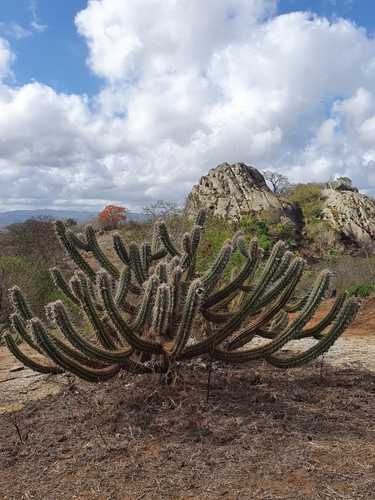
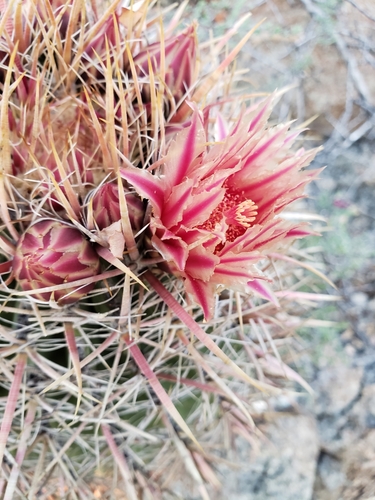
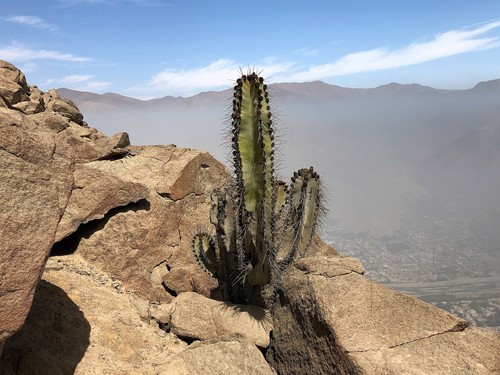
Neoraimondia arequipensis grows in a shrub-like form, branching at the base and not forming a distinct central trunk. Its large, upright shoots can grow up to 10 m (33 ft) in height and up to 40 cm (16 in) in diameter. Shoots have 5 to 8 ribs. This cactus has the largest areoles of any cactus species; its conspicuous, cone-shaped areoles can reach up to 10 cm (4 in) long, and are less than half as wide as they are long. Each areole bears up to 7 spines, which can grow as long as 25 cm, with documented maximum lengths of up to 24 cm (9.4 in). The species is an ingredient source for cimora, a psychoactive beverage. Its greenish-white to pink-red flowers grow up to 3 cm (1.2 in) in diameter. The flower pericarpel is covered in short hairs, and sometimes has faint, hard-to-spot spines. Its round fruits are purple, reaching up to 7 cm (2.8 in) in diameter, and are covered in brownish, felt-like areoles that bear short thorns. Neoraimondia arequipensis is endemic to Peru, where it occurs across multiple regions of the country including Arequipa, Ayacucho, Cajamarca, Huancavelica, Lima, Lambayeque and Piura. It most often grows in rocky coastal habitats, desert scrub, and inter-Andean valleys, at altitudes between 0 and 2,800 meters above sea level. This species is harvested for firewood used to fuel brick ovens. It is also used as a medicinal plant, where its outer epidermis is prepared as a remedy for menopause symptoms, and grown locally as an ornamental plant.