About Neolamarckia cadamba (Roxb.) Bosser
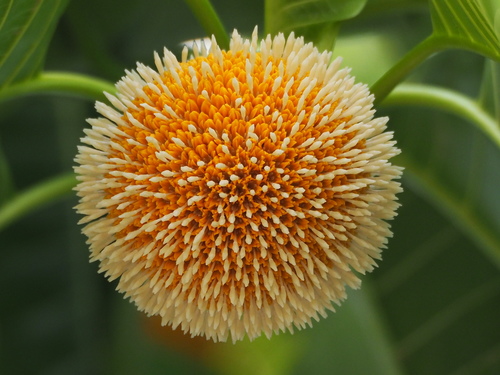
Neolamarckia cadamba (Roxb.) Bosser is a large, fast-growing tree. A fully mature individual can reach up to 45 m (148 ft) in height, with a straight cylindrical trunk, a broad crown, and broad spreading branches. It grows most rapidly in its first 6–8 years. The trunk typically reaches a diameter of 100–160 cm, though most mature trunks are smaller than this range. Its leaves measure 13–32 cm (5.1–12.6 in) long. Flowering usually begins when the tree is 4–5 years old. Its flowers are sweetly fragrant, colored red to orange, and grow in dense, globular heads around 5.5 cm (2.2 in) in diameter. The fruit of this species forms from many small, fleshy capsules packed tightly together to create a single fleshy yellow-orange infructescence that holds approximately 8000 seeds. When the fruit matures, it splits apart to release its seeds, which are then dispersed by wind or rain. Floral features include 5 stamens inserted on the corolla tube with short filaments and basifixed anthers; an inferior ovary that is two-locular, sometimes four-locular in its upper section; an exserted style with a spindle-shaped stigma. Fruitlets are numerous, their upper sections containing 4 hollow or solid structures. Seeds are trigonal or irregularly shaped. The sapwood is white with a light yellow tinge that turns creamy yellow when exposed, and is not clearly differentiated from the heartwood. Neolamarckia cadamba is native to southern China, the Indian subcontinent (northern and western India, Bangladesh, Nepal, Sri Lanka), and Southeast Asia (Cambodia, Laos, Myanmar, Thailand, Vietnam, Indonesia, Malaysia, Papua New Guinea, Australia). It has been introduced to Puerto Rico, where it grows in Toro Negro State Forest. The larvae of Moduza procris, a brush-footed butterfly, and Arthroschista hilaralis, a moth, feed on this tree, and its flowers attract pollinators. Reportedly, the fruit and inflorescences of Neolamarckia cadamba are edible by humans. Fresh leaves are used as fodder for cattle. This species is grown as an ornamental plant, and for low-grade timber and paper production. Its timber is used for plywood, light construction, pulp and paper, boxes and crates, dug-out canoes, and furniture components. Kadamba pulp has satisfactory brightness and performs well as a hand sheet. The wood can be easily impregnated with synthetic resins to increase its density and compressive strength. At 15% moisture content, the wood has a density of 290–560 kg per cubic meter, a fine to medium texture, straight grain, low luster, and no characteristic odor or taste. It is easy to work with both hand and machine tools, cuts cleanly, leaves a very good finished surface, and is easy to nail. The timber air dries rapidly with little or no structural degrade. Kadamba wood is very easy to preserve using either open tank or pressure-vacuum systems. It is one of the most frequently planted trees in the tropics. It is grown along avenues, roadsides, and in villages to provide shade, and is suitable for use in reforestation programs. It sheds large volumes of leaf and non-leaf litter; decomposition of this litter improves several physical and chemical properties of the soil under the tree's canopy, including increasing levels of soil organic carbon, cation-exchange capacity, available plant nutrients, and exchangeable bases. A yellow dye can be obtained from the species' root bark. Kadamba flowers are an important raw material for producing 'attar', an Indian perfume with a sandalwood (Santalum spp.) base, where the kadamba essence is extracted via hydro-distillation. An extract of the leaves is used as a mouth gargle. The bulbous fruiting infructescence is edible and consumed raw in Northern India, where it is described as fragrant, sweet with a slight tangy taste, and widely enjoyed as a relish. Leaf extract has recently been used to produce silver nanoparticles for surface-enhanced Raman spectroscopy.