About Neogaerrhinum filipes (A.Gray) Rothm.
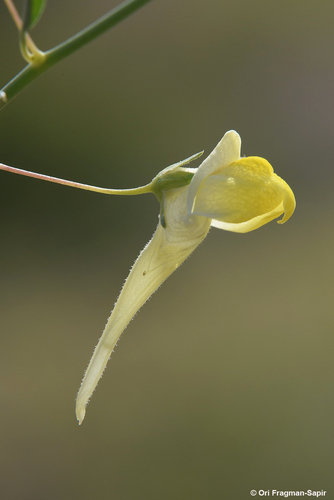
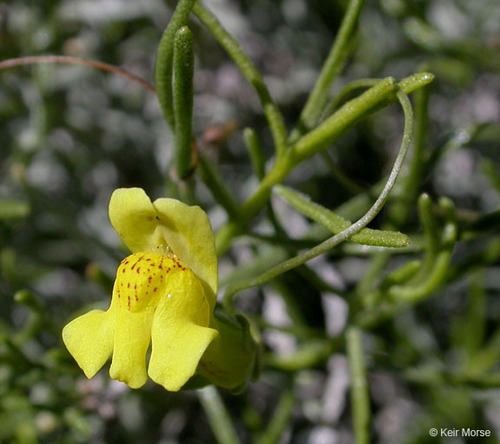
Neogaerrhinum filipes, or scientific name Neogaerrhinum filipes (A.Gray) Rothm., is a hairless herbaceous annual plant. It grows long, thin, vine-like stems that climb on other objects, including other plants, for support, and winds around the small branches of other plants for protection. The base of the stem is woolly, the stem itself is non-glandular, and stems can reach between 9 and 100 centimeters long when winding over other plants. Both stems and leaves are bright green. Its leaf petioles (the stalk that connects the leaf blade to the stem) are 0 to 5 millimeters long, and leaf blades measure 6 to 50 millimeters. Leaves are lanceolate, or lance-tip shaped, and can also be linear to ovate in shape. The inflorescence is made up of a single flower borne at the tip of a tendril-like, thread-like pedicel (the stalk that connects the individual flower to the inflorescence). The pedicel measures 3 to 10 centimeters long, coils tightly to help the plant climb, and can intertwine around the stems of other plants. These pedicels are even thinner and longer than those of similar snapdragon species native to the Mohave Desert. The single flower is just over one centimeter long, bright yellow to gold in color, dotted with dark maroon speckles. The combined corolla, or all of the flower's petals together, is 10 to 13 millimeters long. Flowers of this species self-pollinate through cleistogamy, meaning they are fertilized while still closed buds and do not need to open. After flowering, the plant produces fragile ovoid to spherical fruit that is 3 to 5 millimeters long. Seeds are 1 millimeter long, black, wing-shaped, and marked with 4 to 6 thick ridges. This species is native to the sandy deserts of the southwestern United States and northern Mexico. Documented locations where it grows include slopes in the Grand Canyon, the Mohave Desert, and the Sonoran Desert. It can be found at elevations up to 1650 meters. Its flowering season runs from March to May. Because its stems are usually covered by the leaves and twigs of other low bushes, the plant is often hidden and hard to spot.