About Neofelis nebulosa (Griffith, 1821)
This species is Neofelis nebulosa (Griffith, 1821), commonly called the clouded leopard.
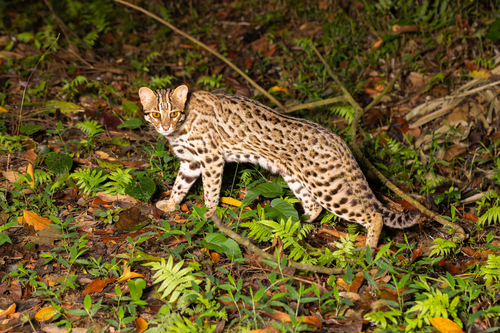
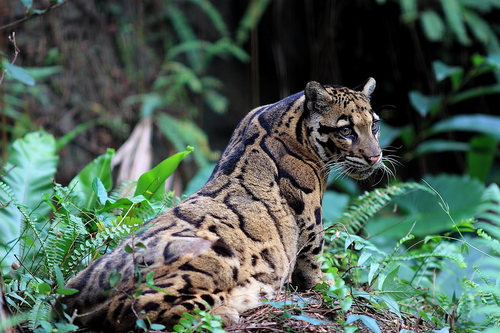
The clouded leopard’s fur has a dark grey or ochreous base color, which is often mostly covered by a pattern of black and dark dusky-grey blotches. Its head has black spots, and its ears are entirely black. Partly fused or broken stripes run from the corner of the eyes across the cheek, from the corner of the mouth to the neck, and along the nape to the shoulders. Elongated blotches continue down the spine and form a single median stripe on the loins. Two large dark dusky-grey blotches on the sides of the shoulders each have a dark stripe on their posterior edge; this stripe continues to the foreleg, where it breaks up into irregular spots. The flanks are marked with dark dusky-grey irregular blotches, which are bordered on the back by long, oblique, irregularly curved or looped stripes. The cloud-like pattern formed by these blotches gives the species its common English name. The underparts and legs are spotted, and the tail has large, irregular, paired spots.
Its legs are short and stout, and its paws are broad; females are slightly smaller than males. Its hyoid bone is ossified, which allows it to purr. Its pupils contract into vertical slits, and its irises range from brownish yellow to grayish green. Melanistic individuals are uncommon. Compared to other big cats, it has relatively short limbs; its hind limbs are longer than its front limbs to improve jumping and leaping ability. Its ulnae and radii are not fused, which also increases its range of motion when climbing trees and stalking prey.
Clouded leopards weigh between 11.5 and 23 kg (25 and 51 lb). Females have a head-to-body length of 68.6 to 94 cm (27.0 to 37.0 in) with a tail 61 to 82 cm (24 to 32 in) long. Males are larger, with a head-to-body length of 81 to 108 cm (32 to 43 in) and a tail 74 to 91 cm (29 to 36 in) long. Shoulder height ranges from 50 to 55 cm (20 to 22 in). Its skull is long and low, with strong occipital and sagittal crests. Its canine teeth are exceptionally long; the upper canines are around three times as long as the basal width of their socket. The first premolar is usually absent, and the upper canines measure 4 cm (1.6 in) or longer. It has a bite force of 544.3 Newtons at the canine tip, and a bite force quotient of 122.4 at the canine tip. It is often called a "modern-day sabre-tooth" because it has the largest canines relative to its body size of any living cat.
The clouded leopard is found from the Himalayan foothills of Nepal, Bhutan and India east to Myanmar, southeastern Bangladesh, Thailand, and Peninsular Malaysia, and also south of the Yangtze River in China. It is locally extinct in Singapore and Taiwan. It was previously thought to be extinct in Nepal, but individuals were found there in 1987 and 1988; it has since been recorded in Shivapuri Nagarjun National Park, Annapurna Conservation Area, and between 2014 and 2015 it was recorded in Langtang National Park at elevations between 1,823–3,498 m (5,981–11,476 ft). In India, it occurs in the states of Sikkim, northern West Bengal, Tripura, Mizoram, Manipur, Assam, Nagaland and Arunachal Pradesh, as well as in the Meghalaya subtropical forests. A clouded leopard was photographed in semi-evergreen forest at 144 m (472 ft) elevation in Pakke Tiger Reserve. In Sikkim’s Khangchendzonga Biosphere Reserve, camera traps photographed clouded leopards at 2,500–3,720 m (8,200–12,200 ft) elevation between April 2008 and May 2010. Sixteen individuals were recorded in Manas National Park during a survey from November 2010 to February 2011. Between January 2013 and March 2018, it was also recorded in Dampa Tiger Reserve, Eaglenest Wildlife Sanctuary, Singchung-Bugun Village Community Reserve, Meghalaya’s Nongkhyllem Wildlife Sanctuary, and the Balpakram-Baghmara landscape. In Bhutan, it has been recorded in Royal Manas National Park, Jigme Singye Wangchuck National Park, Phibsoo Wildlife Sanctuary, Jigme Dorji National Park, Phrumsengla National Park, Bumdeling Wildlife Sanctuary, and multiple unprotected areas. In Bangladesh, it was recorded in Sangu Matamuhari in the Chittagong Hill Tracts in 2016. In Myanmar, camera traps recorded it for the first time in the hill forests of Karen State in 2015. In Thailand, it lives in relatively open dry tropical forest in Huai Kha Khaeng Wildlife Sanctuary, and in closed-forest habitats in Khao Yai National Park. In Laos, it has been recorded in dry evergreen and semi-evergreen forests in Nam Et-Phou Louey National Protected Area. In Cambodia, it was recorded in deciduous dipterocarp forest in Phnom Prich Wildlife Sanctuary between 2008 and 2009, and in Central Cardamom Mountains National Park, Southern Cardamom National Park, Botum Sakor National Park, and Phnom Samkos Wildlife Sanctuary between 2012 and 2016. In Peninsular Malaysia, it was recorded in Taman Negara National Park, Ulu Muda Forest, Pasoh Forest Reserve, Belum-Temengor, and Temengor Forest Reserve, as well as in a small number of connecting areas between 2009 and 2015. The last confirmed record of the Formosan clouded leopard dates to 1989, when the skin of a young individual was found in Taroko National Park. It was not detected during an extensive camera trapping survey that ran from 1997 to 2012 across more than 1,450 sites inside and outside of Taiwan’s protected areas.
The clouded leopard is a solitary cat. Early descriptions frame it as a rare, secretive, arboreal, and nocturnal animal that lives in dense primary forest. It is one of the most skilled climbers among cats. Captive individuals have been observed climbing down vertical tree trunks head first, and hanging from branches by bending their hind paws around branchings. They are capable of supination, and can hang from branches using only their hind paws and tail. They can jump up to 1.2 m (3 ft 11 in) high. They use trees as daytime resting sites, but also spend time on the ground hunting at night. Captive clouded leopards scent mark by spraying urine and rubbing their heads on prominent surfaces. Their vocalizations include short high-pitched meows and loud crying calls, both used when an individual is trying to locate another, at either short or long distances. When they meet in a friendly interaction, they prusten and raise their muzzle; when aggressive, they produce a low-pitched growl and hiss, with exposed teeth and a wrinkled nose. Radio-collared clouded leopards are primarily active at night, but also have crepuscular activity peaks; individuals recorded in northeast India are most active in the late evening after sunset.
Home range sizes have only been estimated in Thailand. In Phu Khieo Wildlife Sanctuary, four individuals were radio-collared from April 2000 to February 2003. The home ranges of the two females were 25.7 km2 (9.9 sq mi) and 22.9 km2 (8.8 sq mi), while the two males had home ranges of 29.7 km2 (11.5 sq mi) and 49.1 km2 (19.0 sq mi). In a 1997 to 1999 study in Khao Yai National Park, two individuals were radio-collared: the female had a home range of 39.4 km2 (15.2 sq mi) and the male had a home range of 42 km2 (16 sq mi); both shared a core area of 2.9 km2 (1.1 sq mi). In 2016, camera trapping in the Khlong Saeng Wildlife Sanctuary and Khao Sok National Park forest complex detected 15 individuals in a 200 km2 (77 sq mi) core zone, with an estimated population density of 5.06 individuals per 100 km2 (39 sq mi). Only 12 individuals were detected in a 297 km2 (115 sq mi) more human-disturbed edge zone, with an estimated density of 3.13 individuals per 100 km2 (39 sq mi).
Both male and female clouded leopards reach first reproduction at an average of 26 months of age. Females are in estrus for approximately six days, with an estrous cycle of around 30 days. In the wild, mating most often occurs between December and March. A mating pair will mate multiple times over several days. The male grasps the female by the neck, and the female responds with vocalization. The male occasionally bites the female during courtship, and is very aggressive during sexual encounters. Females can produce one litter per year, and males do not participate in raising cubs. After a gestation period of 93 ± 6 days, females give birth to litters of one to five cubs, most often three. Cubs are born with closed eyes, weigh 140 to 280 g (4.9 to 9.9 oz), and have solid dark spots rather than the adult’s dark ring-shaped spots. Their eyes open after around 10 days. They become active within five weeks, and are fully weaned at around three months of age. They develop the adult coat pattern at around six months, and become independent at around 10 months of age. Captive clouded leopards have an average lifespan of 11 years, and one individual has lived to almost 17 years old. The generation length of the clouded leopard is approximately seven years.