About Neofavolus alveolaris (DC.) Sotome & T.Hatt.
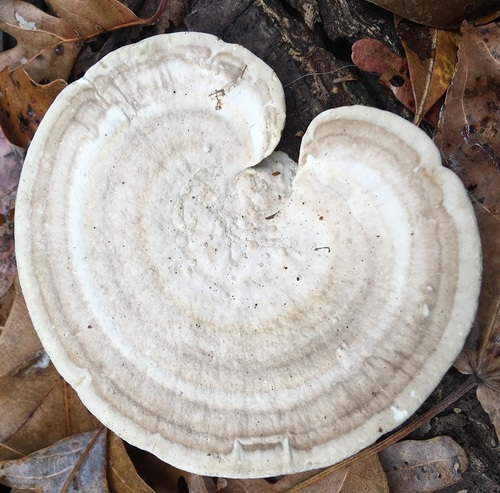
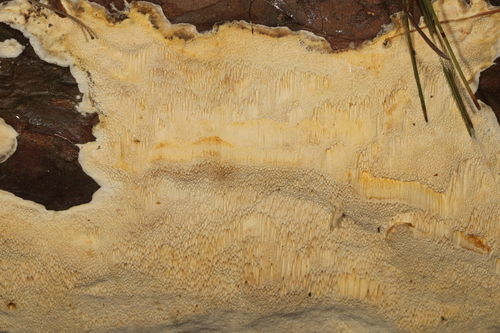
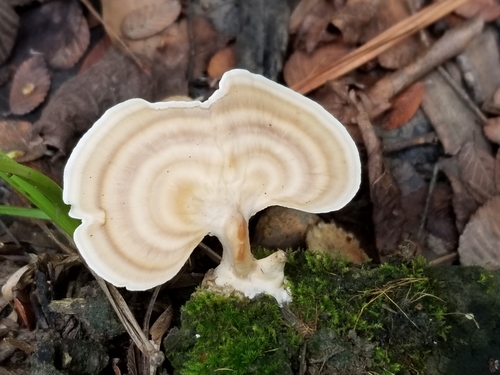
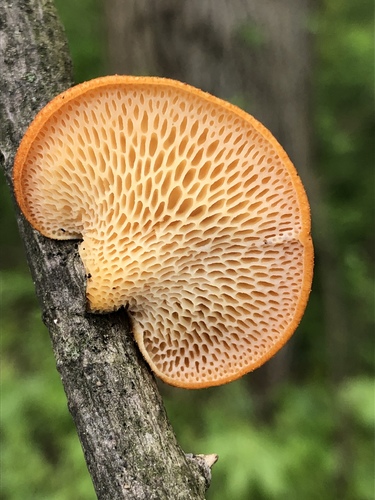
Neofavolus alveolaris (DC.) Sotome & T.Hatt. has kidney-shaped caps that are cream-colored with reddish scales. Caps measure 1.5–6 cm across, and 5–10 millimeters thick near the base. The light-colored flesh of this fungus hardens as it ages. The whitish stipe widens where it connects to the cap, and measures 0.5–1 cm long and 3–7 mm thick. The pores are whitish when young, turning yellow as they mature. The pores are decurrent, meaning they extend down the length of the stipe, measure 0.5–3 mm across, and are rectangular to hexagonal in shape, becoming rounder closer to the cap margin. The spore print of this species is white. Neofavolus alveolaris grows singly or in groups on branches and twigs of hardwoods, and is commonly found on shagbark hickory during spring and early summer. It has been recorded growing on dead hardwoods from the following genera: Acer, Castanea, Cornus, Corylus, Crataegus, Erica, Fagus, Fraxinus, Juglans, Magnolia, Morus, Populus, Pyrus, Robinia, Quercus, Syringa, Tilia, and Ulmus. Collections of this species have been made in Europe (Czechoslovakia, Italy, and Portugal), China, and Australia. It was once thought to be widely distributed across eastern North America, but specimens originally identified as this species may actually belong to N. americanus. This mushroom is edible when young, and has been described as "edible but tough" — toughness increases with age, and it does not have a particularly distinctive flavor. Another source lists Neofavolus alveolaris as inedible. A polypeptide with antifungal properties called alveolarin has been isolated from fresh fruit bodies of this species. Alveolarin inhibits the growth of four fungal species: Botrytis cinerea, Fusarium oxysporum, Mycosphaerella arachidicola, and Physalospora piricola.