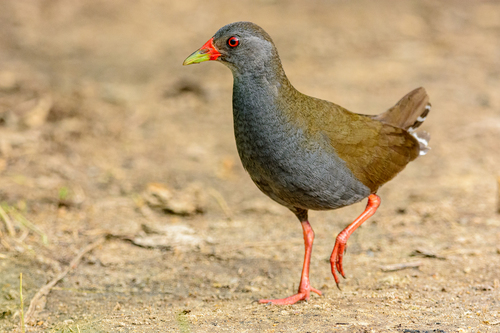
About Neocrex erythrops (P.L.Sclater, 1867)
The paint-billed crake (Neocrex erythrops) is 18 to 20 cm (7.1 to 7.9 in) long and weighs approximately 40 to 70 g (1.4 to 2.5 oz). One measured specimen had a wing length of 20 cm (7.9 in), a tarsus length of 2.8 cm (1.1 in), and a weight of 43 g (1.5 oz). The species gets its common name from its red and yellow bill, and it has bright red legs. Males and females of this species are identical in appearance. The nominate subspecies has brown coloring on its crown, nape, upperparts including the tail; a white throat, and gray coloring on its face, throat, and breast; its flanks, belly, and vent have black and white barring. Subspecies N. e. olivascens is similar to the nominate, but is darker overall and has less white on the throat. For distribution, the nominate subspecies of paint-billed crake occurs in coastal Ecuador, coastal Peru, and the Galápagos Islands. Subspecies N. e. olivascens is much more widespread, though it occupies several widely separated ranges. In Central America, it is found in Costa Rica and Panama. On the South American mainland, it occurs in Argentina, Bolivia, Brazil, Colombia, French Guiana, Guyana, Paraguay, Peru, Suriname, and Venezuela. It has been recorded as a vagrant on Trinidad, and in the U.S. states of Texas and Virginia. This species lives in a wide variety of landscapes, ranging from very wet areas such as reedbeds and marshes, to wet and dry pastures and rice fields, fairly dry bushy areas, and humid woodlands in the Galápagos. In South America, it appears to prefer swamp and savanna habitats with abundant grass and thickets. Its elevation range extends from near sea level to almost 3,400 m (11,200 ft).