About Nemobius sylvestris (Bosc, 1792)
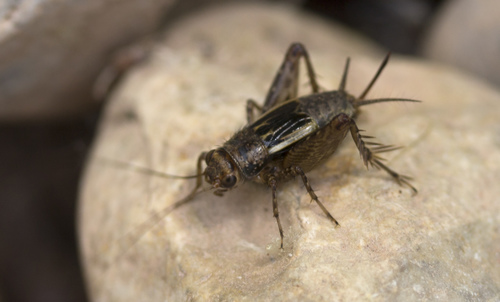
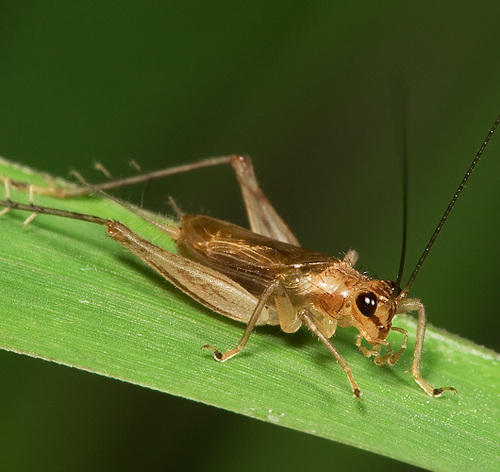
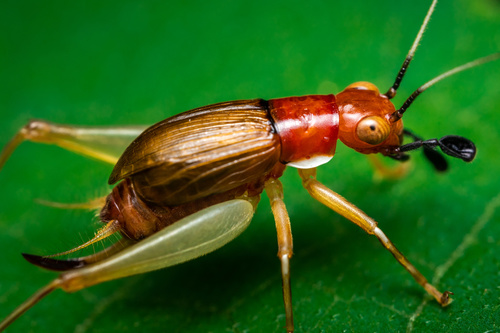
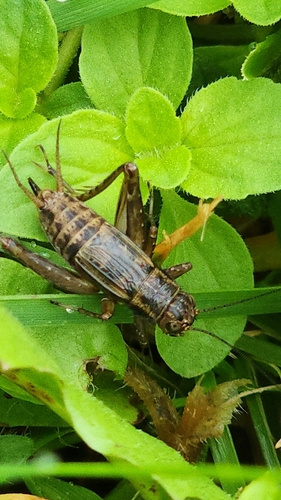
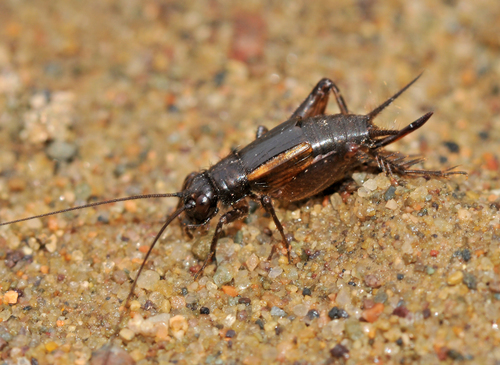
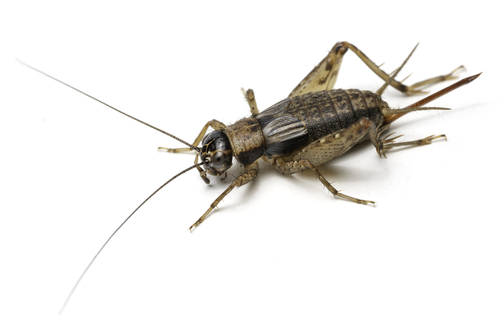
This small ground-dwelling insect, commonly called the wood cricket, is dark brown and grasshopper-like, with long thread-like antennae. It reaches a total length of around 1 cm (0.4 in). Neither males nor females of this species have hind wings. In males, the forewings extend halfway along the abdomen, while in females the forewings are reduced to rounded stubs. Females also have a long ovipositor at the tip of the abdomen. The wood cricket is native to Europe and North Africa. Its native range covers Western, Central and Southern Europe, Corsica, Algeria, and Morocco. Its natural habitat is forest edges and woodland clearings, where it occurs alongside oak, beech, hazel, and holly trees, as well as bracken. It grows best among leaf litter in warm, sunny locations. It is uncommon in Britain, with three separate established populations in the New Forest, the Isle of Wight, and southern Devon. In 2001, a new population appeared near Offwell in eastern Devon after coniferous woodland and rhododendron were cleared from the site; the nearest previously known population was around Harpford, approximately 11 km (7 mi) away. Surrey’s only population of Nemobius sylvestris is found on Wisley Common, after the species was accidentally introduced with a delivery of azaleas to Wisley Gardens in 1967. Because of the wood cricket’s limited range in the United Kingdom, it is listed as a species of special conservation concern. A 2022 study recorded that the wood cricket has been recently introduced to North America, and this is the first species of the genus Nemobius to be found on the continent. Small populations of Nemobius sylvestris have been documented in the U.S. states of New York and Washington. Wood crickets live within decaying leaf litter, which they feed on. They may also eat the fungus that grows among the leaf litter. When temperatures are high enough, males stridulate (produce their calling song) during both day and night. Their loud two-tone call is hard to pinpoint the source of, especially when multiple calling males are close together. When disturbed, these crickets leap away using their powerful hind legs, or hide in leaf litter or among low-growing vegetation. Eggs are laid in leaf litter during summer and autumn. The species overwinters either as eggs or nymphs, and young individuals mature by June. Unusually for members of the grasshopper family, wood crickets live for two years. As flightless insects, their dispersal ability is limited. Males have been recorded dispersing over 55 m (180 ft) away from the woodland edge, but females and nymphs move much shorter distances. Dispersal along the edge of woodland is more feasible for this species.