About Nematolepis squamea (Labill.) Paul G.Wilson
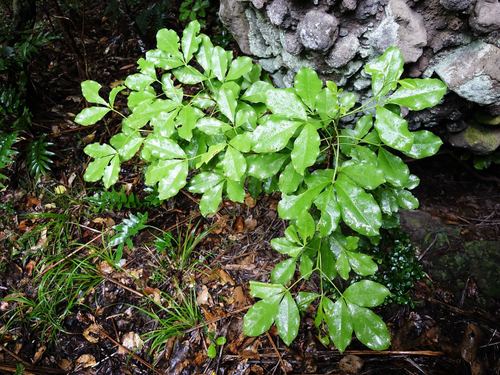
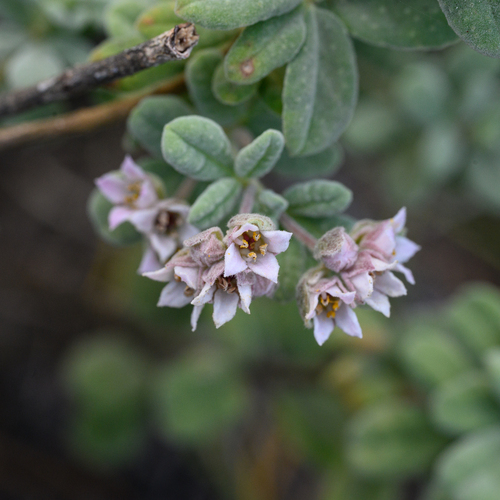
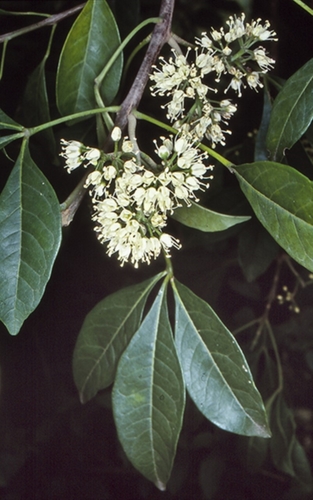
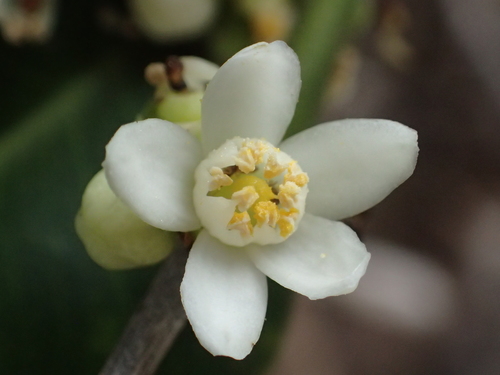
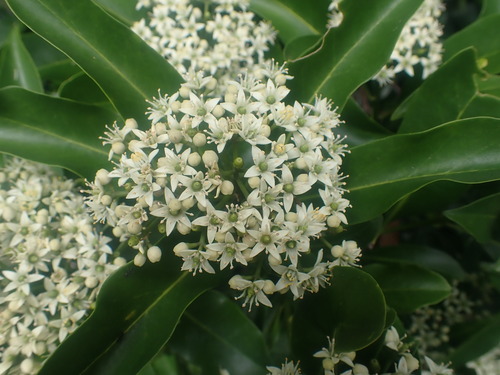
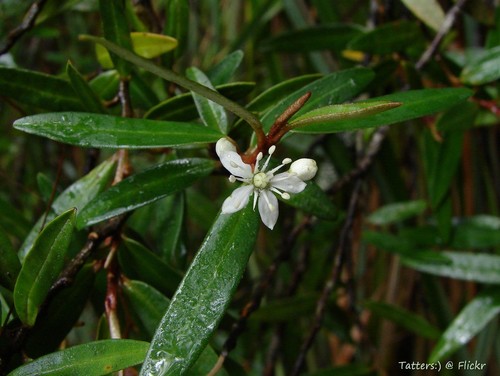
Nematolepis squamea (Labill.) Paul G.Wilson is an erect, conical shrub or small tree that can reach up to 12 meters in height. It produces simple, entire, opposite leathery leaves that are glossy green on the upper surface, and silvery and scaly on the underside. The leaves are lanceolate in shape with a prominent central midrib, and typically measure 2.5 to 8 cm long and up to 2 cm wide. New growth stems are often red-brown in color and covered in scales. The leaves contain oil glands, and release an aromatic scent when crushed. Individual small white flowers are around 1 cm in diameter, and grow in conspicuous clusters of up to 20 flowers in leaf axils. Each flower has five petals and five stamens, and flowering takes place between October and December. The fruit capsules are star-shaped, with four or five points. The subspecies retusa, which is endemic to Tasmania, always grows as a shrub. It has rounded leaf apexes, shorter leaves, and twigs that are highly scaly and warty. Nematolepis squamea is distributed across Tasmania and the south-eastern regions of mainland Australia, where it grows in moist, well-drained sites. It is common in wet sclerophyll forests, rainforests, gullies, and riverbanks from the coast up to 800 m in altitude. In drier, more alpine areas, it grows as a shrub. The timber of Nematolepis squamea, known as satinwood, or lancewood in the timber industry, is dense and hard, with a golden, silky appearance. It is well suited to wood turning and veneer work, and was used for cabinet making in the past. Nematolepis squamea is a hardy, reliable species for cultivation. It prefers moist, well-drained soil and a partly shaded location. It can tolerate moderate frost, but cannot survive extended dry conditions. Like other members of the Rutaceae, it is most easily propagated from cuttings. It can be clipped and pruned to shape, and is used as a hedge or screen plant.