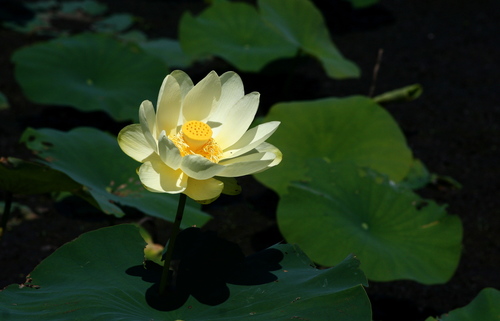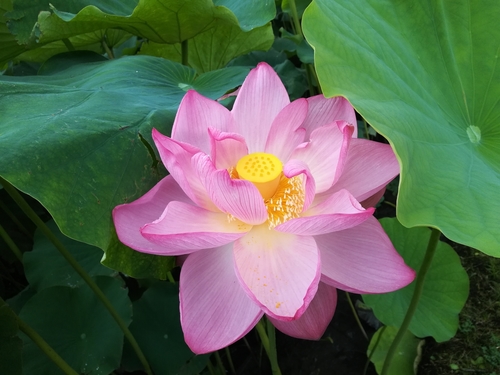
About Nelumbo nucifera Gaertn.
Nelumbo nucifera Gaertn., commonly known as the lotus, is an aquatic perennial plant adapted to grow on the floodplains of slow-moving rivers and delta areas. Each year, established lotus stands release hundreds of thousands of seeds to the bottom of the water body. Some seeds sprout immediately, while most are consumed by wildlife. Remaining seeds can stay dormant for a long time as the pond fills with silt and dries out. When flood events occur, sediments holding the seeds break open; the dormant seeds then rehydrate and establish new lotus colonies. Lotus plants are cultivated in nutrient-rich, loamy, typically flooded soils, requiring warm temperatures and specific planting depths. They can be propagated via rhizomes, seeds, or tissue culture. Harvest of stolons, flowers, seeds, and rhizomes is done by hand or machine, over a period of several months that varies based on climate and cultivated variety. Nelumbo nucifera is the national flower of India, and is the unofficial national flower of Vietnam. It produces large temperature-regulating leaves and flowers, forms extremely long-lived seeds, and contains bioactive alkaloids. Under favorable conditions, its seeds may stay viable for centuries; the oldest recorded germinated lotus seed was 1,300 years old, recovered from a dry lakebed in northeastern China. Because of this long seed viability, Chinese culture regards the lotus as a symbol of longevity. The species has a very broad native distribution, ranging from central and northern India (found at altitudes up to 1,400 m or 4,600 ft in the southern Himalayas) through northern Indochina and East Asia, reaching as far north as the Amur region. Russian populations of the lotus are sometimes classified as the separate species Nelumbo komarovii, and there are isolated native populations at the Caspian Sea. Today, the species also grows in southern India, Sri Lanka, nearly all of Southeast Asia, New Guinea, and northern and eastern Australia, but these populations are likely the result of human introduction. The lotus has a 3,000-year history of cultivation for its edible seeds, and is commonly grown in water gardens. It is a highly symbolic, versatile plant used for religious offerings, especially in Hinduism and Buddhism, and incorporated into diverse culinary traditions across Asia. Its flowers, seeds, and rhizomes are valued for spiritual, cultural, and nutritional purposes. It holds deep cultural, spiritual, and religious significance across Hinduism, Buddhism, Jainism, Ismailism, and Chinese culture, symbolizing purity, enlightenment, spiritual awakening, and divine beauty, and is widely depicted in art, architecture, and literature. The leaves of Nelumbo nucifera contain the flavonol miquelianin and alkaloids including coclaurine and norcoclaurine, while the whole plant contains bioactive compounds such as nuciferine and neferine. These constituents have been studied for their potential pharmacological effects, and the plant is used in traditional medicine and marketed as a functional food in many cultures. In botanical terms, lotus roots grow in the soil at the bottom of ponds or rivers, while leaves either float on the water surface or are held well above it. Leaf stalks (petioles) can reach up to 200 cm (6 ft 7 in) in length, allowing the plant to grow in water of that depth. The peltate leaf blade can have a diameter between 80 and 100 cm (2 ft 7 in – 3 ft 3 in). Leaves are spaced up to 2 m (6 ft 7 in) apart along the rhizome, which can grow as much as 20 m (66 ft) in a single year. The rhizome's internodes are not cylindrical, but are swollen at their midsection. For cultivation, sacred lotus grows in water from 30 cm (12 in) to 2.5 m (8 ft 2 in) deep. Deeper water more effectively protects the plant's tubers and supports better growth and flowering in colder climates. Lotus seeds germinate at temperatures above 13 °C (55 °F). Most varieties are not naturally cold-hardy, but can adapt readily to year-round outdoor growth in USDA hardiness zones 6 through 11; some growers have even had success growing them in zones as low as 4 or 5, and plants adapt better to warmer zones with higher zone numbers. In the northern hemisphere, the growing season runs from April to September, and requires an average daytime temperature of 23 to 27 °C (73 to 81 °F). In regions with low winter light levels, the sacred lotus enters a dormant period. Tubers are not cold-resistant when removed from water and exposed to air, but when kept underwater in soil, energy-dense tubers can survive winter temperatures below 0 °C (32 °F). If plants are removed from water for winter storage, which is most common in exceptionally cold climates, tubers and roots must be stored in a stable, frost-free location such as a garage, preferably inside a cardboard box or container completely filled with vermiculite or perlite, with full insulation of the tubers. Nelumbo nucifera has high potential for use in wastewater treatment to remove polluting compounds and heavy metals. It can grow in variable water conditions and at low light intensity. Multiple studies have confirmed the successful use of N. nucifera to reduce water eutrophication. Floating lotus leaves block sunlight from reaching lower water layers, which suppresses algae growth in lotus aquatic systems; as a result, oxygen content is up to 20% higher than in aquatic systems dominated by other plants. Nitrogen and phosphorus pollution from intensive agriculture are major issues in aquatic systems, and N. nucifera can assimilate more phosphorus than other aquatic plants currently used for water remediation, such as water hyacinth. It also assimilates nitrogen through denitrification, and creates habitat for beneficial bacterial growth in the water body. Rhizofiltration by lotus allows efficient removal of heavy metals including arsenic, copper, and cadmium from water. Observed results are impressive: 96% of copper and 85% of cadmium are removed after a seven-day incubation period. Heavy metal accumulation does not cause visible morphological symptoms of metal toxicity, but the safety of lotus rhizomes for human consumption grown in treated water requires further study. Currently, most harvested lotus rhizomes are consumed fresh, because they have a poor shelf life that makes long-term storage uncommon. This limits export opportunities for producer countries in Asia. Rhizomes lose water quickly, undergo oxidation, and experience changes to their nutrient composition within a short time after harvest. The optimal temperature range for storing rhizomes is 5 to 8 °C (41 to 46 °F). There are three main approaches to rhizome storage. Simple stacking of rhizomes can keep them fresh for approximately three weeks. Stacking rhizomes in alternating layers with silver sand and soil prevents water loss, keeping rhizomes fresh for up to two months, but this method is intended for home use rather than commercial sale. Hydrogen sulfide fumigation reduces enzymatic browning to maintain rhizome quality. Dipping rhizomes in a salt solution prevents oxidation and bacterial growth, allowing storage for up to five months and improving export potential, but this treatment is associated with high cost and an inefficient cleaning process required before the rhizomes can be eaten. Nelumbo nucifera produces thermally stable proteins that may be useful in protein bioengineering processes. These proteins support the seed's longevity by enabling cell protection and repair under stress conditions. There is also evidence that compounds from N. nucifera are used in the development of pharmaceutical drugs for human health research targeting multiple conditions. Lotus leaves have hydrophobic properties caused by a waxy surface coating that repels water adhesion. This characteristic inspired the concept of the "lotus effect" in biomimicry and engineering, guiding the design of water-resistant, self-cleaning materials. Researchers at the National University of Singapore used the lotus's water-repelling structure as inspiration to develop eAir, an aero-elastic sensor that can detect subtle pressure changes and other environmental stimuli. Other uses of the lotus include its distinctive dried seed heads, which resemble the spouts of watering cans, and are widely sold around the world for decoration and dried flower arrangements. A unique fabric called lotus silk, made from lotus plant fibers, is produced only at Inle Lake, Myanmar and Siem Reap, Cambodia. This fiber is used to weave special robes for Buddha images called kya thingan, or lotus robe. All parts of Nelumbo nucifera are edible, with rhizomes and seeds being the most commonly consumed parts. Traditionally, rhizomes, leaves, and seeds have been used in folk medicine, Ayurveda, Chinese traditional medicine, and other oriental medicine practices. In Chinese medicine, lotus seeds are still used as lian zi xin. Lotus rhizomes, seeds, and their processing by-products are widely consumed in Asia, the Americas, and Oceania for their high content of physiologically active substances. In China specifically, lotus seeds have been popular for around 3,000 years; as early as the Han Dynasty, the Shen Nong's Herbal Classic recorded lotus seeds as sweet, astringent, and nourishing to the heart and kidney. Today, there are 22 cultivated varieties belonging to four known Chinese lines, grown primarily in Jianning, known as "the town of Jianlian lotus seeds in China", and Guangchang, known as "the town of white lotus seeds in China". This perennial aquatic herb is growing in popularity due to its nutraceutical properties and historical importance, and developing different lotus parts into commercial functional food products would increase its economic value. Due to its benefits for human health and richness in nutrients and bioactive substances, the Chinese Ministry of Health has approved Nelumbo nucifera for use as both food and medicine.