About Nelumbo lutea (Willd.) Pers.
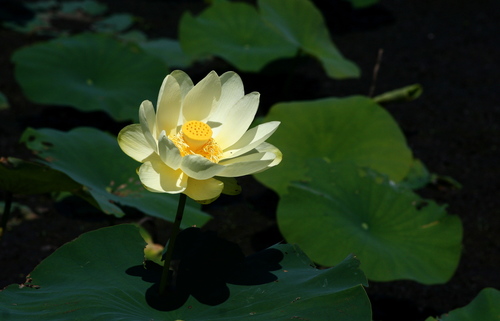
Nelumbo lutea (Willd.) Pers., commonly called American lotus, is an emergent aquatic plant. It grows in lakes, swamps, and areas that experience regular flooding. Its roots anchor in underwater mud, while its leaves and flowers grow above the surface of the water. Leaf petioles can grow up to 2 m (6.6 ft) long, ending in a round leaf blade that measures 33–43 cm (13–17 in) across. Mature plants reach an overall height between 0.8 and 1.5 m (2.6 and 4.9 ft). Flowering starts in late spring and can continue through summer. The specific epithet lutea means "yellow" in Latin, and refers to the plant's flowers, which range in color from white to pale yellow. Flowers measure 18–28 cm (7.1–11.0 in) in diameter and have between 22 and 25 petals. This species is native to an area extending from Minnesota to Oklahoma, Florida, Mexico, Honduras, and the Caribbean. Indigenous communities that used the plant for food and medicine likely helped expand its distribution further north and east across North America. Ecologically, Nelumbo lutea acts as the larval host plant for the American lotus borer moth, Ostrinia penitalis. It may be the plant called "macoupin" in the Miami-Illinois language. The plant produces a large tuberous rhizome that is used as a food source. Its seeds are also edible, and are commonly known as "alligator corn". Its seed-like fruits can be shaken loose from the plant and are also edible. Unopened leaves and young stalks can be cooked and eaten. The Wyandot people mixed this plant with acorns to create food during periods of famine. The Meskwaki people cooked the plant's seeds with corn, and prepared winter food by cutting terminal shoots crosswise, stringing them, and drying them. Nelumbo lutea is also widely planted as an ornamental in ponds, valued for its foliage and flowers. American lotus spreads via creeping rhizomes and seeds. It has been crossed with Nelumbo nucifera to produce many hybrids. To propagate from seeds, gardeners scarify the pointed tip of the seed with a file, then soak it in water. Propagation can also be done by dividing established plants.