About Necturus maculosus (Rafinesque, 1818)
Taxonomy
The common mudpuppy, with the scientific name Necturus maculosus (Rafinesque, 1818), is a species of salamander in the family Proteidae.
Habitat Type
It lives a fully aquatic life in lakes, rivers, and ponds across parts of North America.
Paedomorphosis Trait
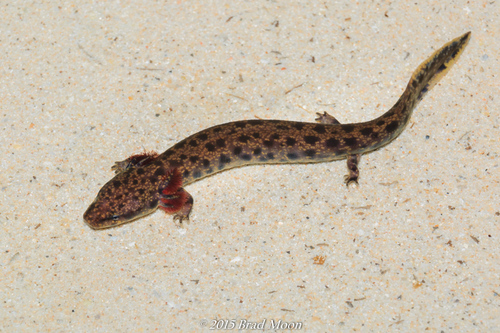
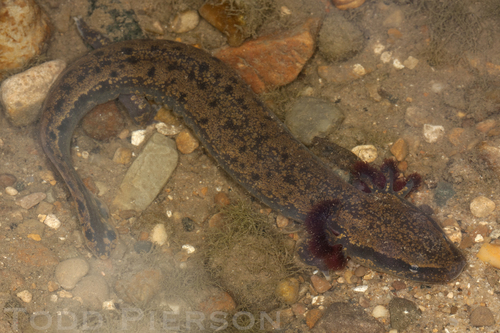
This species undergoes paedomorphosis and retains its external gills throughout life.
Respiration Method
Since gas exchange through skin and lung respiration alone is not enough, common mudpuppies rely on their external gills as their primary method of gas exchange.
Coloration
Their bodies are usually rusty brown, and they reach an average total length (including the tail) of 13 inches (330 mm).
Activity Pattern
Common mudpuppies are nocturnal, and are only active during the day if the water they inhabit is murky.
Diet
They are generalist feeders, and their diet includes almost any prey they can capture, such as insects, mollusks, earthworms, and other annelids.
Female Fecundity Basics
After a female common mudpuppy reaches sexual maturity at six years of age, she lays an average of 60 eggs.
Lifespan
In the wild, the average lifespan of a common mudpuppy is 11 years.
Native Range Habitat
The native range of Necturus maculosus covers streams, lakes, and ponds in eastern North America.
Native Distribution Boundaries
Their native distribution extends from southern Canada as far south as Georgia, and from the Midwestern United States east to North Carolina.
Introduced Population
There is also an introduced established population in Maine.
Diurnal Shelter Behavior
Behaviorally, common mudpuppies hide under cover like rocks and logs during the day, and become more active at night.
Environmental Activity Flexibility
In murky, muddy waters, they may be active during the day, and they can even survive under the ice when lakes freeze over.
Sexual Maturity Timeline
Common mudpuppies require six years to reach sexual maturity.
Mating Timing
Mating usually occurs in autumn, but females do not lay eggs until much later.
Male Breeding Morphology
When males are ready to breed, their cloacae swell.
Spermatophore Deposition
Males deposit spermatophores on the environment’s substrate.
Sperm Storage Process
Females pick up these spermatophores with their cloaca, and store the sperm in a small specialized gland called a spermatheca, until ovulation and internal fertilization occur.
Fertilization Timing
Fertilization typically happens just before females lay eggs in the spring.
Pre-Oviposition Male Behavior
Before egg deposition, male mudpuppies leave the nesting area.
Oviposition Site
When ready, females deposit their eggs in a protected location, most commonly on the underside of a rock or log.
Clutch Size Range
Clutch sizes range from 20 to 200 eggs, with an average of 60 eggs per clutch.
Egg Characteristics
The eggs are unpigmented, and measure around 5–6 mm (0.20–0.24 in) in diameter.
Egg Incubation
The female remains with her eggs throughout the incubation period, which lasts around 40 days.
Hatchling Development
When they hatch, hatchlings are about 2.5 cm (0.98 in) long, and grow to 3.6 cm (1.4 in) before their yolk sac is fully consumed.