About Necrosyrtes monachus (Temminck, 1823)
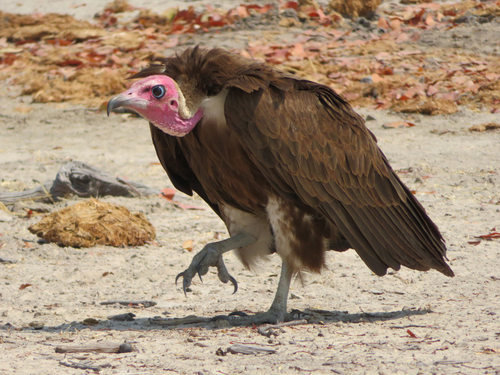
The hooded vulture, with the scientific name Necrosyrtes monachus, is an Old World vulture belonging to the order Accipitriformes, a group that also includes eagles, kites, buzzards, and hawks. It is the only species in the genus Necrosyrtes, which is a sister group to the larger genus Gyps. Both genera are part of the Aegypiinae subfamily of Old World vultures. This species is native to sub-Saharan Africa, with a widespread distribution across southern, East, and West Africa. It is a small, scruffy-looking vulture with dark brown plumage, a long thin bill, and bare skin on its crown, face, and fore-neck, while its nape and hind-neck are covered in downy feathers. Its face is typically light red in color. It usually scavenges on carcasses of both wild and domestic animals. While it remains a common species with a stable population in the lower Casamance region, some areas of The Gambia, and Guinea-Bissau, other regions such as Dakar, Senegal have experienced more than an 85% population decline over the past 50 years. Threats to the species include poisoning, hunting, habitat loss, and collisions with electricity infrastructure. In its 2022 assessment, the International Union for Conservation of Nature (IUCN) has rated the hooded vulture's conservation status as critically endangered. The highest current regional density of hooded vultures is in western The Gambia. In terms of distribution, although hooded vultures have relatively small home ranges, they are widely distributed across Africa. In West Africa, they occur in Senegal, Mauritania, Guinea-Bissau, The Gambia, Niger, and Nigeria. In East Africa, they are found in Chad, Sudan, South Sudan, Ethiopia, Rwanda, and Somalia. In southern Africa, they have been recorded in northern Namibia, Botswana, Zimbabwe, Mozambique, and South Africa. Within South Africa, the species is essentially restricted to Kruger National Park and surrounding protected areas in Mpumalanga and Limpopo provinces, though vagrant individuals have been recorded further west in Kwa-Zulu Natal and Kgalagadi Transfrontier Park. Ecologically, like other vultures, hooded vultures are scavengers. They feed mostly on carcasses of dead animals and waste, which they locate by soaring over savanna and around human settlements, including waste dumps and abattoirs. They also feed on insects, and will gather in large numbers during insect emergences—for example, termite emergences, where they associate with Steppe Eagles. They are non-specialized, highly versatile scavengers and are commensal with humans in West Africa. In West Africa, they often move in flocks of 50 to 250 individuals, especially when foraging at abattoirs or elephant carcasses. In contrast, in southern Africa they are solitary and secretive, making them hard to spot when nesting. They are known to follow scavenging African wild dogs and hyenas. This vulture is typically unafraid of humans, and frequently gathers around human habitations. Local people sometimes refer to it as the "garbage collector". On Ghanaian university campuses, significantly more hooded vultures are found in residential areas than in non-residential areas, and their population densities correlate with the academic calendar—their numbers increase during school terms. According to interviews, 45% of students at these campuses are defecated on by hooded vultures at least once a month. Southern African hooded vulture populations have smaller home ranges than most other Old World vulture species for which data is available, though less is known about the home ranges of East and West African populations. They are most active during the day, and their ranges are smaller during the dry breeding season, when their movement is constrained by a nest site they must return to regularly to incubate eggs and provision fledglings. For both northern and southern hemisphere populations, breeding occurs during the dry summer season. They prefer to build nests in well-foliaged trees along watercourses, with the nest placed in a prominent fork within the tree canopy at an average height of over 15 meters. However, they have also been observed in a variety of biomes, including some where tall trees are rare. They have been recorded in open grasslands, deserts, wooded savanna, forest edges, and along coasts. They tend to occur in higher densities where populations of larger Gyps vultures are low or non-existent. They occur at elevations up to 4,000 meters, but are most numerous below 1,800 meters. Hooded vultures lay a clutch of one egg. The incubation period lasts 46 to 54 days, followed by a fledging period of 80 to 130 days. Young vultures remain dependent on their parents for a further 3 to 4 months after fledging. Measurements of nesting success at the Olifants River Private Nature Reserve in South Africa showed a success rate of 0.44 to 0.89 offspring per pair per year in 2013, and 0.50 to 0.67 offspring per pair per year in 2014.