About Necrophila americana (Linnaeus, 1758)
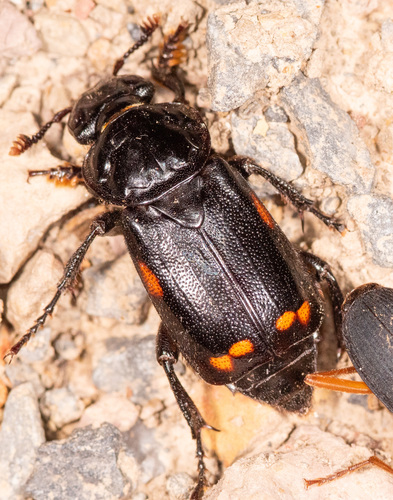
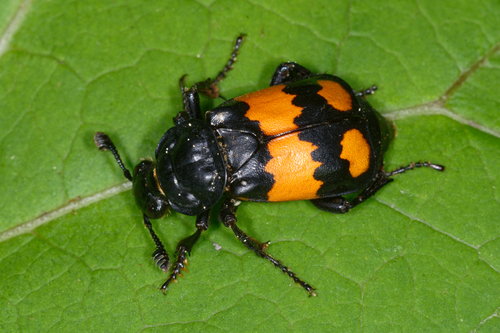
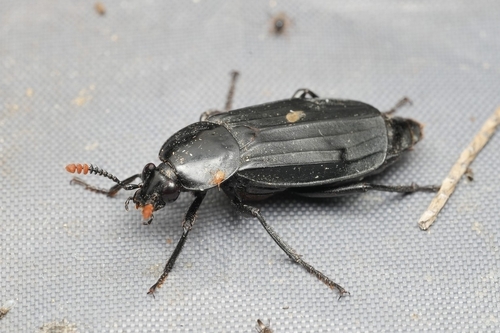
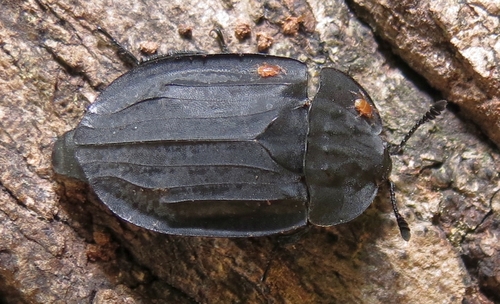
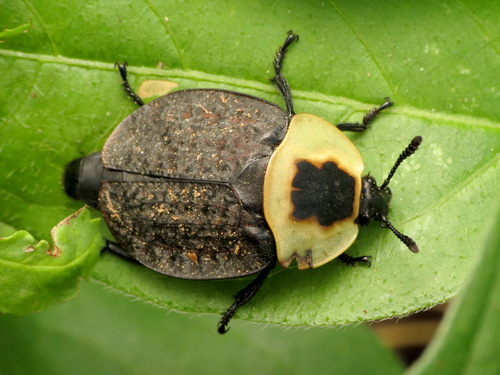
The American carrion beetle, with the scientific name Necrophila americana (formerly known as Silpha americana), is a member of the beetle family Silphidae native to North America. It lays its eggs in raw flesh (especially dead animal flesh) and fungi, and its larvae consume these materials. Both larvae and adult American carrion beetles also eat fly larvae and the larvae of other competing carrion beetles that share the same food sources. This species prefers marshy and wooded habitats, and adults emerge from the larval stage in early summer. Bombus ashtoni, a cuckoo bumble bee, is a close mimic of the American carrion beetle. Because the species tends to thrive on large carcasses, it is important to forensic studies. The American carrion beetle lives in North America east of the Rocky Mountains. Its range extends south from eastern Texas to Florida, and north from Minnesota to southeastern Canada, including New Brunswick and Maine. Dense populations of this beetle have been found in eastern Kansas. In one collection of 140 specimens, over half (65%) were found in wooded areas, and 25% were found in marginal areas of woods. The species is often found in open fields, and rarely found in open meadows. In habitats where trees are present, the beetles prefer humid habitats with thick, overgrown trees over meadows or fields. Other studies have found American carrion beetles living in Typha marsh habitats, which have high water accumulation and heavy rainfall. The beetles prefer marshes over wooded areas like forests, and prefer both marshes and wooded areas over open meadows, where they are rarely found. American carrion beetles go through three instar larval stages with different body sizes at each stage. First instar larvae are between 10 and 15 millimeters long, second instar larvae between 13 and 21 millimeters, and the final third instar averages 23 millimeters in length. The entire life cycle of the species is thought to take around 10 to 12 weeks. From spring through fall during daylight hours, adult beetles arrive at a carcass a few hours after flies first arrive. Immediately upon arrival, the adults begin eating newly hatching fly larvae, mate, and lay their own eggs. Adults will stay and continue eating competing larvae for as long as the carcass lasts, to give their own larvae the best chance to eat and grow. After hatching, larvae eat both the carcass and other larvae present on it. Fly larvae digest part of the carcass, and beetle larvae consume the portions fly larvae leave behind, which typically include the flesh remaining on bones and on the moist inner face of the carcass. Once fully developed, larvae leave the carcass, fall to the ground, dig into soil, and pupate. Adult American carrion beetles overwinter as adults. This ground-dwelling silphid beetle emerges from the larval stage to feed on carcasses in early summer, and reaches its greatest abundance from June through October. It arrives earlier in the decomposition process than other beetles, which are most prominent in late August. Although the species feeds on carcasses, it does not show any form of parental care. Adult Necrophila americana can be captured in pitfall traps baited with carcasses. Their consistent appearance has been documented multiple times at a study site in Indiana, with consistent observed abundance. They can also be captured in pitfall traps baited with isopropanol. While these traps capture other insects, it is unlikely that they attract carrion beetles via volatiles from other insect carcasses. Instead, isopropanol likely acts as a kairomone, as male and female beetles show no difference in preference for it. It is possible that beetles perceive isopropanol as a chemical produced by decomposing bodies during the bloating stage, which explains the attraction of Necrophila americana to it.