About Necrodes littoralis (Linnaeus, 1758)
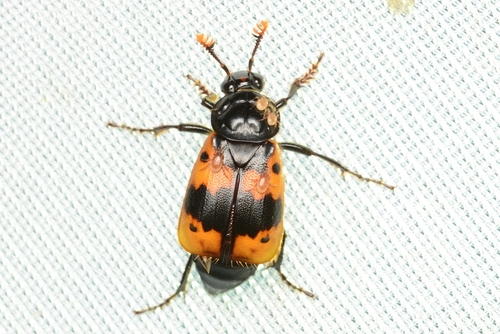
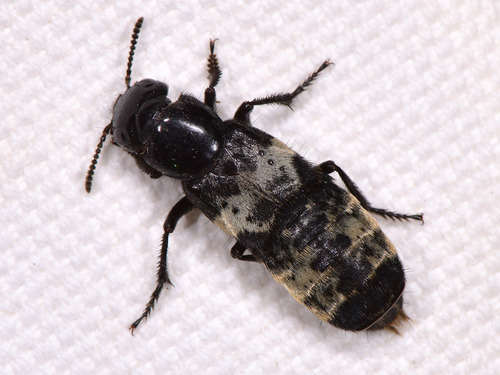
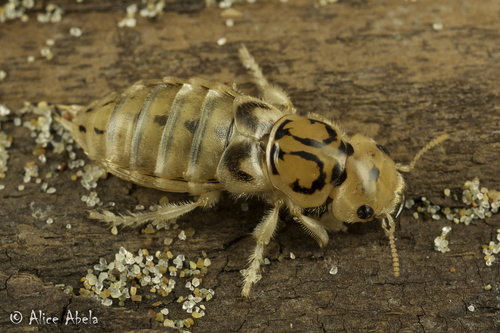
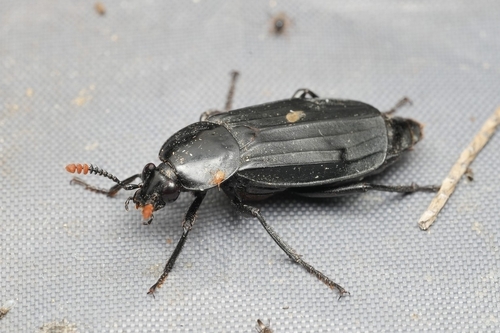
Adults of Necrodes littoralis reach 15 to 25 mm (0.59 to 0.98 in) in length, and have a shiny black body. This species can be identified by a distinct bump located approximately three-quarters of the way along the length of its elytra — hardened forewings that act as armor to protect the beetle from environmental conditions and predators. Like all beetles in the order Coleoptera, N. littoralis has truncated, or shortened, elytra. It remains unclear why some beetle species evolved this shortened protective armor. The larvae of N. littoralis are campodeiform, meaning they have a flattened body, antennae, and well-developed legs. N. littoralis has a Palearctic distribution, with most recorded observations coming from Europe. It has been documented in Austria, Hungary, Slovakia, Czech Republic, Belgium, France, and England. Outside of Europe, N. littoralis has been observed in South Korea. Both adult and larval N. littoralis are primarily found on large carrion in the late stages of decomposition, and this carrion is usually located outdoors. However, there have been recorded observations of N. littoralis on indoor carrion. Researchers hypothesize that the beetles struggle to access decaying bodies indoors, as they cannot easily find openings into buildings. In 2021, Italian researchers reported the first recorded presence of N. littoralis on a human corpse in Italy. The decomposition stage of the corpse when it was found matches the established understanding that this beetle species colonizes corpses during later decomposition stages. The corpse was found indoors, which the researchers explain was likely possible because "the access to the building through the open door and the state of total neglect of the area where the corpse was found ... may have favored the indoor colonization by N. littoralis." Mating of adult N. littoralis typically takes place at night. After mating, females lay eggs in the ground near carrion. While the exact number of eggs varies, females lay between 50 and 70 eggs in a single clutch. Studies of larval development confirm that N. littoralis has three larval stages: first instar, second instar, and third instar. The full developmental sequence from larva to adult beetle includes the post-feeding larva, prepupa, pupa, teneral adult, and imago (mature adult) stages. When first instar larvae hatch, they are creamy white, and move toward carrion to feed. First instar larvae are the most vulnerable to threats. Second and third instar larvae are also creamy white immediately after ecdysis, the process by which insects shed their exoskeleton. To transition from third instar larvae to post-feeding larvae, third instar larvae burrow into the ground and form pupal chambers by "thrashing the abdomen and thus compacting the soil around them". They progress through the prepupal, pupal, and teneral adult stages inside these chambers. The beetles only emerge from the pupal chamber after they become fully sclerotized and develop their full adult coloration.