About Nebula salicata ablutaria (Boisduval, 1840)
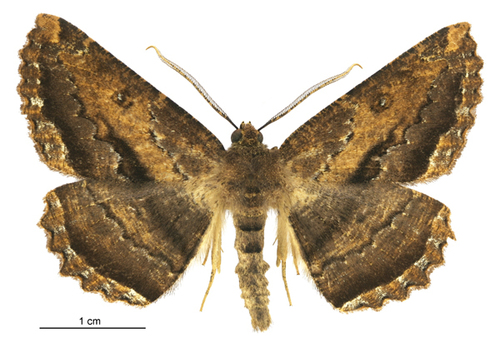
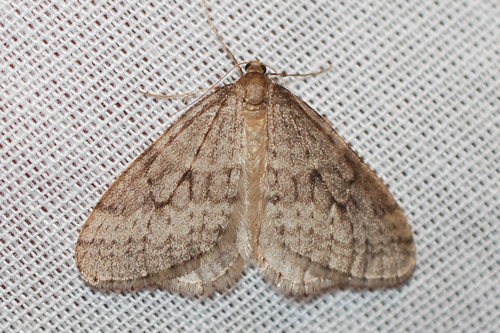
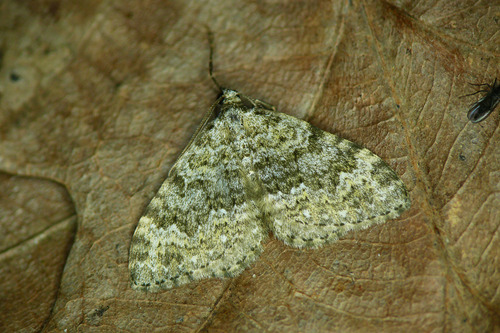
Coenotephria salicata, commonly known as the striped twin-spot carpet, is a moth species belonging to the family Geometridae. It was first described by Michael Denis and Ignaz Schiffermüller in 1775, and it occurs in most of Europe. This moth has a wingspan of 29 to 31 mm. Adult moths have a grey base wing colour, marked with darker cross lines that are hard to distinguish when the forewings are heavily mottled. Broken white lines run along the outer margin of the forewings. The larvae are moderately stout and pale reddish brown. They have a dark dorsal line finely edged with pale colour, a fine yellowish subdorsal line, and a broad yellow lateral stripe. Their spiracles are black, their tubercles are small and black, and their setae are short. Adult moths are active in flight from May to July. Occasionally, a partial second generation emerges in autumn. The larvae feed on plants from the Galium genus. The subspecies Nebula salicata ablutaria was originally described by Boisduval in 1840.