About Nebria brevicollis (Fabricius, 1792)
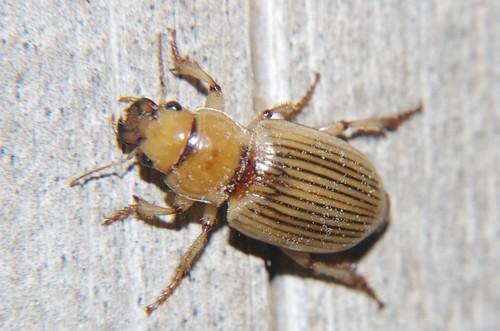
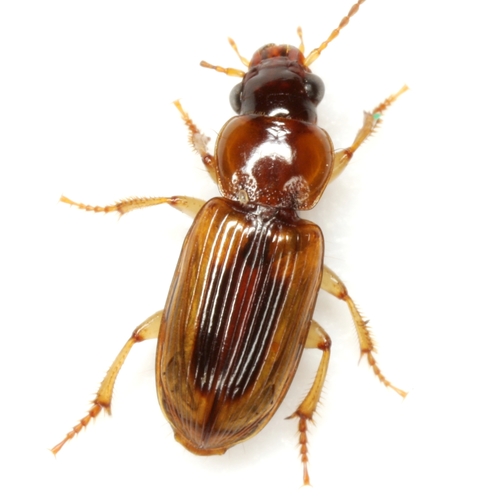
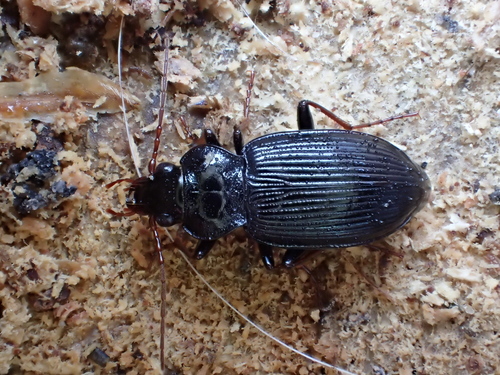
Nebria brevicollis (Fabricius, 1792) is a modestly sized ground beetle, with adults measuring 10–14 mm in length. It has a dark brown body, with reddish-brown tibiae, tarsi, palpi, and antennae. Its pronotum has two lateral setae on each side, and is densely punctuate across its base. This species has two sets of wings, which are protected by a hard black or dark brown outer shell. Only a small number of individuals have functional flight muscles, and no sexual dimorphism has been observed between males and females. It is nocturnally active, and is most abundant between October and December, then again from January through mid-May. This species is widespread across the globe; it is found in nearly all European countries and islands. In 2008, it was reported as an introduced species in western Oregon, United States, and has since been found in Washington state, northern California, and southern British Columbia, Canada. In the Pacific Northwest of North America, it occurs in both highly disturbed sites and native old-growth forest stands, and has been recorded on mountain summits, in mountain forests, and in mountain meadows at elevations over 1200 meters. Its rapid range expansion across North America has led researchers to question whether it qualifies as an invasive species, as its detection rate and fast spread into Oregon match common traits of invasive species. Nebria brevicollis occupies an extremely broad ecological range, documented from Europe to North America across diverse harsh environments, from sea beaches to alpine caves. In Oregon, its ecological range is unrivaled by any other carabid beetle species. Its primary habitat is shaded leaf litter in deciduous forests, but it also occurs in disturbed areas including parks, gardens, and agricultural lands. Unlike other species in the genus Nebria, it actively avoids moist areas. Nebria brevicollis is a nocturnal, opportunistic omnivorous predator. It feeds on Mollusca, earthworms, small insects, other beetles in both larval and adult (imaginal) life stages, small fly species, spiders, and mites. Total body length acts as an important constraint on its food source choice: most of its prey is less than 4 mm long. Researchers have hypothesized that N. brevicollis competes for food with the beetle Pterostichus algidus. Its foraging behavior involves walking up and down grass stalks and wandering across lupine leaves; this ability to forage both horizontally and vertically across its environment allows it to access a larger pool of prey resources. Like other ground beetles, Nebria brevicollis is used as an effective bioindicator for studying the environmental impacts of human activity. Changes in ground beetle communities that include this species can be used to track habitat alterations from urbanization, pollution, and harmful land management practices. Environmental pollution can alter soil pH, sodium content, and calcium content in this beetle's habitat, and has been observed to cause physiological and behavioral changes in the beetles themselves. Research has confirmed that soil properties can shape carabid communities that include N. brevicollis. Changes in species count or abundance of these beetles can be correlated with human-caused habitat alterations, and changes in the reproductive ability of ground-dwelling beetles like N. brevicollis can also signal negative effects of environmental pollution. More research is needed to confirm these correlations.