About Nauclea orientalis (L.) L.
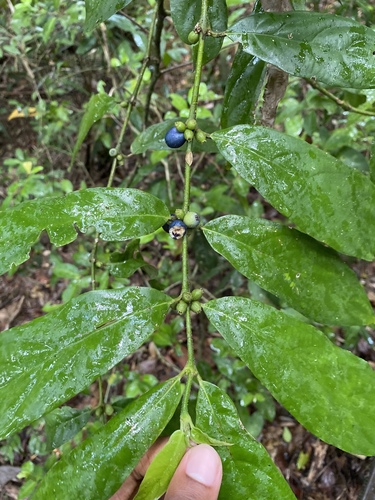
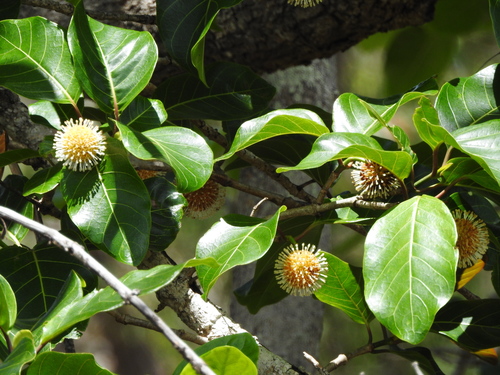
Nauclea orientalis (L.) L., commonly called the Leichhardt tree, is a medium to tall deciduous tree that reaches a maximum height of around 30 m (98 ft) and a trunk diameter of 1 m (3.3 ft). It sheds its leaves during the dry season. The outer bark is grayish to reddish-brown, and may be smooth, fissured or flaky; when cut, the inner bark is orange to yellow in color. Its broadly ovate, smooth (glabrous) leaves are arranged oppositely, and measure around 7 to 30 cm (2.8 to 11.8 in) long by 4 to 18 cm (1.6 to 7.1 in) wide. The upper leaf surface is glossy green, while the underside has prominent raised yellow venation. Like most species in the Rubiaceae family, Leichhardt trees have interpetiolar stipules. In the genus Nauclea, these interpetiolar stipules are held erect and pressed together, forming strongly flattened vegetative buds. The stipules are large, around 1 to 3.5 cm (0.39 to 1.38 in) long, and their inner surfaces bear a number of small red glands that resemble insect eggs.
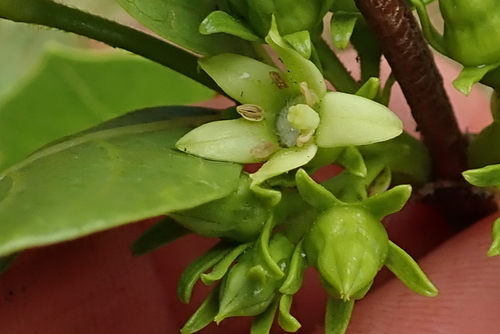
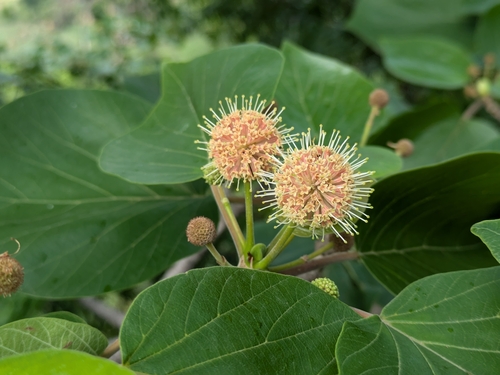
The small, fragrant, tubular flowers are yellowish to orange with white stamens, and are grouped into a spherical cluster originating from a central point around 3 cm (1.2 in) in diameter. Flowering occurs from September to January in Australia, and from August to October in the Philippines. Individual flowers measure about 8 to 10 mm (0.31 to 0.39 in) long and 3 to 5 mm (0.12 to 0.20 in) in diameter. Each flower has a perianth with five petals and five sepals arranged in separate whorls. The inner surface of the corolla is yellow to orange and sweet-scented; petals are often partly fused together to form a long corolla tube tipped with individual petal lobes. The flowers are bisexual, with five short, separate stamens attached to the perianth. The calyces are also fused together, which gives the entire flower head its spherical shape. Flowers are epigynous, with an inferior ovary positioned below the attachment point of the other flower parts.
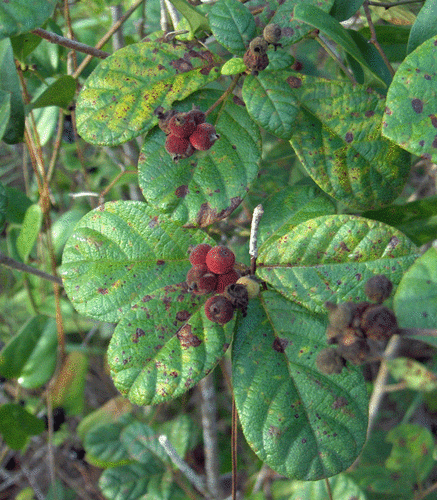
After three months, flower heads develop into a fleshy, globular multiple fruit (syncarp) joined by their fused calyces; each individual flower forms a fruitlet containing one seed. The entire fruit measures around 4 to 5 cm (1.6 to 2.0 in) in diameter, around the size of a golf ball. It is rugose (wrinkled), brown, strongly aromatic, and indehiscent. The ovoid to ellipsoid seeds are small, around 1 to 10 mm (0.039 to 0.394 in) long, not winged, and produced in very large numbers. They do not remain viable for long, and are recalcitrant, meaning they cannot survive drying or freezing temperatures and cannot be stored. Seeds undergo epigeal germination, emerging above ground around 15 days after sowing.
Leichhardt trees usually grow near bodies of water, and prefer alluvial soils. They can grow in environments ranging from rheophyte shrublands in areas frequently subject to flooding, to rainforests where they grow best. They are pioneer species that colonize open areas to facilitate ecological succession. In Australia, they are associated with ecosystems containing red gums and honey myrtles in drier habitats, with brush cherries, Moreton Bay chestnuts, and blush walnuts in wetter areas, and grow alongside honey myrtles in swamps. In the Philippines, they are most commonly found in secondary forests. They grow at elevations from 0 to 500 m (0 to 1,640 ft) above sea level. Their native range extends from tropical northern Australia and New Guinea through Southeast Asia, covering Malesia from the Philippines to Myanmar and Thailand. This is the only species of the genus Nauclea that occurs in Australia, though it can easily be confused in some regions with species from the genus Neolamarckia (= Anthocephalus auct. non A.Rich.).
The tree is cultivated for ornamental use. Its fruits are edible and eaten by Indigenous Australians, though they have a very bitter taste. Fruits are also eaten by flying foxes and birds such as cassowaries. In Malaysia, it is a food source for proboscis monkeys (Nasalis larvatus), along with other Rubiaceae species. The wood is easy to cut, which gives it the common name "cheesewood", but it is not durable when exposed to weather. It has a distinctive yellowish to orange color. The timber is used for frames, internal floorboards, woodcarving, paper production, house construction, and canoe building. Bark is used to make fish poison; the extract is added to slow-moving water to stun fish for easier capture. In folk medicine, bark infusions induce vomiting, and are used by Indigenous Australians to treat stomachaches and animal bites. The plant is also a source of yellow dye. In the Philippines, it is used to treat wounds. Studies on indole alkaloids extracted from Leichhardt trees have indicated possible antimalarial and anticancer effects.