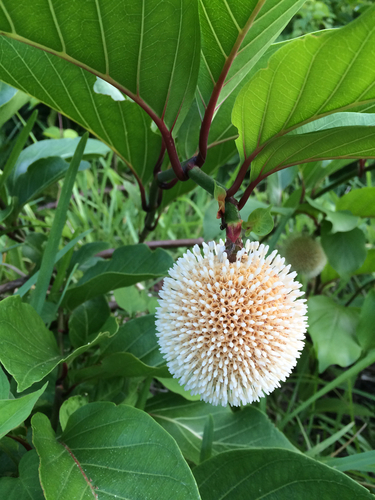
About Nauclea latifolia Sm.
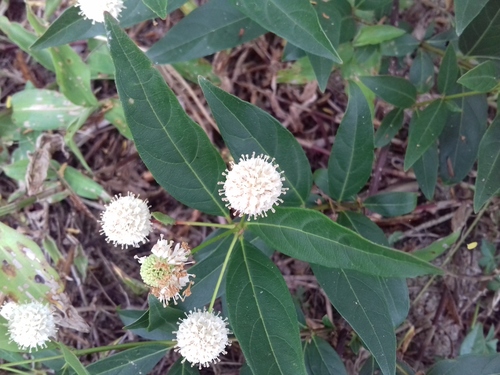
Nauclea latifolia Sm. is an open-canopied shrub or tree that has low branching, and a straggling, multi-stemmed growth habit when young. Its bark is rough, fibrous, and ranges from gray to dark gray in color. The leaves are arranged oppositely, are simple in form, and shaped elliptic to obovate, measuring 10–22 cm long. They have a leathery texture, a glossy green upper surface, and a paler underside marked by prominent pinnate venation. Its inflorescences are solitary terminal spherical heads 4–5 cm in diameter, made up of many small, tubular, fragrant flowers. The fruits are compound syncarps that ripen from green to deep red, and contain sweet, watery pulp that surrounds numerous tiny seeds. This species is native to tropical Africa, with a range extending from Senegal and Gambia in the west, through West and Central Africa, east to Ethiopia and Uganda, and south to Angola. It commonly grows in savanna woodlands, dry forests, and gallery forests along rivers, at elevations from sea level up to approximately 1,200 m. It prefers tropical to subtropical climates with annual rainfall between 1,000 and 2,700 mm, and grows best in well-drained loamy or sandy soils, though it can tolerate poor and disturbed soils. Nauclea latifolia is primarily pollinated by insects, especially bees and butterflies that are attracted to its fragrant flowers. Its fruits are mainly dispersed by frugivorous animals including baboons, monkeys, and birds, which eat the sweet pulp and excrete the seeds away from the parent plant. It acts as an important pioneer species in savanna and riparian ecosystems, contributing to soil stabilization and providing food for wildlife such as elephants and antelopes. Across West and Central Africa, this plant is widely used in traditional medicine. Bark decoctions are most often used to treat malaria, fever, and dysentery; roots are used to address wounds, rheumatism, and pain; leaves are used for diarrhea and respiratory ailments; and fruits are used to treat gastrointestinal disorders. Phytochemical studies have detected indole alkaloids, flavonoids, tannins, saponins, and naturally occurring tramadol in the plant, which supports the reported antimalarial, analgesic, antimicrobial, anti-inflammatory, and antidiadic activities of Nauclea latifolia. The termite-resistant wood of this species is used for firewood, charcoal, and small-scale carpentry. Its edible fruits are eaten as a famine food, while bark and roots are used as sources of natural dyes. During dry seasons, the leaves are also used as livestock fodder.