About Natrix tessellata (Laurenti, 1768)
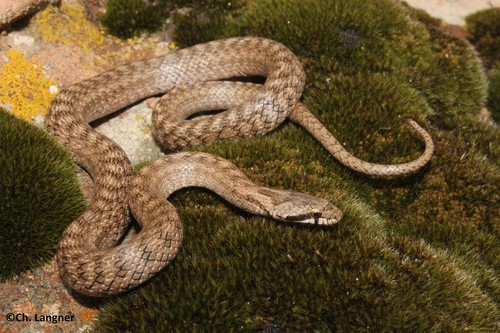
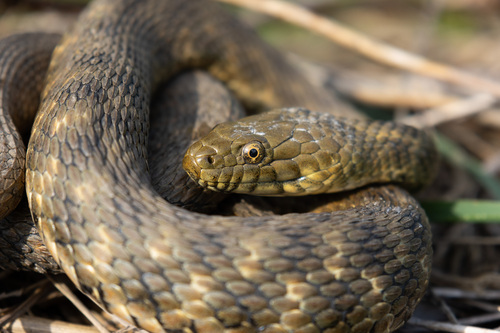
The dice snake, scientifically named Natrix tessellata, is a nonvenomous Eurasian snake species that belongs to the subfamily Natricinae of the family Colubridae. This species has an average adult length of 1.0 to 1.3 meters, which equals 39 to 51 inches. Its body color ranges from greyish green to brownish or almost solid black, with dark spots arranged along its back. The belly of the dice snake is sometimes brightly colored yellow or orange and marked with black spots arranged in a pattern very similar to dice, which gives the species its common name. The dice snake occurs across most of central and eastern Eurasia. Its range extends west to Italy and Czechia, east to Kyrgyzstan, north to Ukraine, and south to Iran. The dice snake lives primarily close to water bodies including rivers, streams, and lakes, and feeds most frequently on fish. It will also occasionally eat amphibians such as frogs, toads, and tadpoles. There is one recorded observation of a dice snake attempting to feed on an olm (Proteus anguinus) that had been flushed out of a cave in Bosnia and Herzegovina after heavy rain; the snake was far too small to successfully consume the olm. Although the dice snake is classified as nonvenomous, its serum contains a potent antihemorrhagin. When threatened, it has several defensive adaptations: it releases a strongly bad-smelling secretion from its cloaca, and it may also use thanatosis, or playing dead, as a defense mechanism. During the March to May mating season, dice snakes gather in large groups. Females typically lay their eggs in July, and each clutch contains between 10 and 30 eggs. Hatchling young snakes emerge in early September. Dice snakes enter hibernation from October to April in dry holes located near the water they inhabit.