About Natrix maura (Linnaeus, 1758)
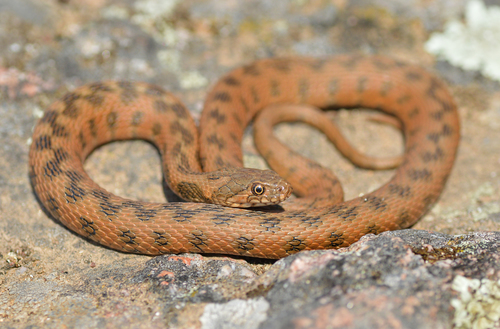
Natrix maura (Linnaeus, 1758), commonly called the viperine snake, has a dorsal base color that can be grey, brown, or reddish. It has a black zigzag stripe running along its vertebral line, and a lateral series of black ocelli that have yellow centers. Its labial scales are yellow, marked with black along their sutures. Each temple bears a diagonal dark band, and a second dark band runs behind the temple on each side of the neck. The ventral side is yellow or red with a black checkered pattern, or entirely black. Its strongly keeled dorsal scales are arranged in 21 rows. It has 147 to 160 ventral scales, a divided anal plate, and 47 to 72 paired subcaudal scales. Full-grown adults can reach a total length of 85 cm (33 inches), with the tail accounting for 17 cm (7 inches) of this total length. This species is distributed across southwestern Europe and northwestern Africa. In Europe, it is found in Portugal, Spain, Andorra, France, northwestern Italy, and Switzerland, and has also spread to areas of England. It was introduced to Mallorca in the Balearic Islands, and this introduced location is not marked on the corresponding distribution map. In Africa, it occurs in Morocco, northern Algeria, northwestern Libya, and northern to central Tunisia. Viperine snakes live in rivers and lakes, and have also been recorded in brackish water habitats.