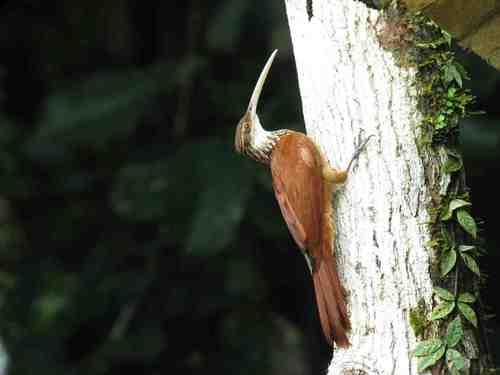
About Nasica longirostris (Vieillot, 1818)
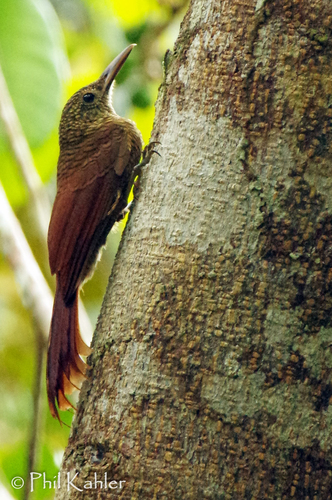
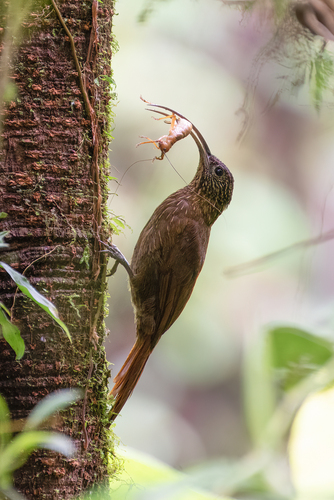
The long-billed woodcreeper, scientific name Nasica longirostris (Vieillot, 1818), is one of the largest woodcreeper species. It has a slim body, small head, long neck, long tail, and an exceptionally long, slightly decurved bill. It measures 34 to 36 cm (13 to 14 in) long and weighs 78 to 92 g (2.8 to 3.2 oz). The sexes have identical plumage. Adult long-billed woodcreepers have blackish brown crowns, napes, and auricular areas marked with whitish buff streaks. They have a white supercilium, white throat, and white foreneck. Their back, rump, wings, and tail are bright cinnamon-rufous to rufous-chestnut, and the tips of their outermost primaries are dark brown. Their breast and sides have black and white streaks; the rest of their underparts are olive-buff with spots and bars. Their iris can be yellowish brown, reddish brown, or dark brown. Their bill ranges from ivory to light gray or yellowish gray, and often has a dusky base on the mandible. Their legs and feet are gray to brown. Juvenile long-billed woodcreepers have paler underparts than adults, sometimes with faint belly barring, and paler, less distinct streaks on the breast. The species is found in the Orinoco River Basin of southern Venezuela, and across the Amazon Basin from eastern Colombia, central Ecuador, north-central and eastern Peru, and northern Bolivia through Amazonian Brazil to the Atlantic Ocean in the Brazilian states of Amapá, Pará, and Maranhão. Its range also extends north into central and eastern French Guiana. The species is seldom found far from water. It primarily inhabits the interior and edges of várzea, river-edge, and swamp forests, as well as well-forested river islands. It occurs less frequently in terra firme and cerrado gallery forests. Most of its population is found below 300 m (1,000 ft) in elevation; it reaches 400 m (1,300 ft) in Colombia and Ecuador, and can be found up to 500 m (1,600 ft) in some other locations.