About Narcissus pseudonarcissus L.
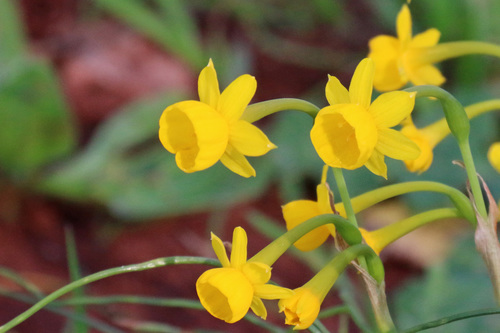
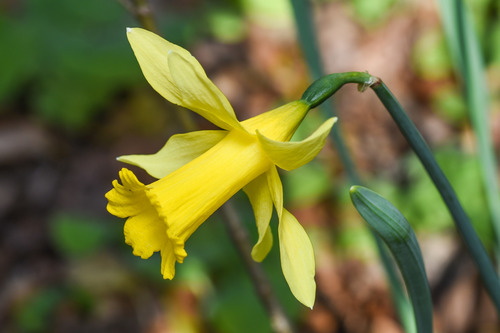
Narcissus pseudonarcissus, commonly called the wild daffodil or Lent lily (known as Cennin Pedr in Welsh), is a perennial flowering plant that grows from a bulb. This species has pale yellow tepals with a darker trumpet-shaped central structure. Its long, narrow leaves are slightly greyish-green and emerge from the base of the stem. Flowers of this plant produce seeds; when seeds germinate, it takes five to seven years for the new plant to reach flowering maturity. Sexual reproduction via seed combines traits from both parent flowers, so when garden hybrid cultivars are grown near wild populations of Narcissus pseudonarcissus, new hybrid seedlings may gain hybrid vigour and out-compete native wild plants. This species is native to Western Europe, ranging from Spain and Portugal east to Germany, and north to England and Wales. It is widely cultivated in gardens, and introduced populations have become established in the Balkans, Australia, New Zealand, the Caucasus, Madeira, British Columbia, Ontario, Newfoundland, Nova Scotia, Oregon, Washington state, most of the eastern United States, and the Falkland Islands. Wild wild daffodils grow in woods, grassland, and on rocky ground. In Britain, native populations have declined sharply since the 19th century, driven by agricultural intensification, woodland clearance, and uprooting of bulbs for garden use. In 1981, it was the focus of a national awareness campaign for wildflower protection in Germany. In England, Farndale valley in the North York Moors National Park holds a large population of the species along the banks of the River Dove. Several nature reserves near Dymock Woods SSSI in Gloucestershire also support large wild daffodil populations, and a Daffodil Walk Trail runs around these reserves during spring. Additionally, many cultivars of N. pseudonarcissus have escaped cultivation and become naturalised across the United Kingdom, where they are often found growing on roadsides, in parks, along streams, and in areas where gardeners have deposited old bulbs along with other removed organic garden material.