About Narcissus poeticus L.
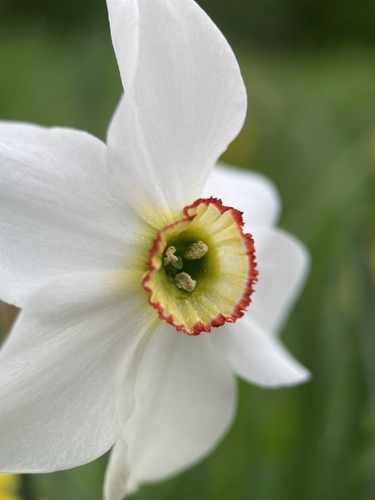
Narcissus poeticus L., commonly known as poet's daffodil, produces extremely fragrant flowers. Each flower has a ring of pure white tepals, and a short light yellow corona with a distinct reddish edge. The plant grows to a height of 20 to 40 cm (7.9 to 15.7 in).
This species is native to central and southern Europe, ranging from Spain and France through Switzerland, Austria, and Slovenia to Croatia, Albania, Greece, and Ukraine. It has become naturalized in Great Britain, Belgium, Germany, the Czech Republic, Azerbaijan, Turkey, New Zealand, British Columbia, Washington state, Oregon, Ontario, Quebec, Newfoundland, and much of the eastern United States, from Louisiana and Georgia north to Maine and Wisconsin.
Like all narcissi, Narcissus poeticus is poisonous if ingested, and it is more dangerous than many other narcissus species. It acts as a strong emetic and irritant. If a large number of these plants are kept in a closed room, their strong scent can be powerful enough to cause headache and vomiting.
The species has a documented history of medicinal use. Dioscorides described it in his *Materia Medica*, noting that when applied with Loliacean meal and honey, it draws out splinters. James Sutherland also mentioned it in his *Hortus Medicus Edinburgensis*. In Korea, it is used to treat conjunctivitis, urethritis, and amenorrhoea.
Poet's daffodil is cultivated in the Netherlands and southern France to produce narcissus oil, its essential oil. This oil is one of the most popular fragrances used in perfumes; it is used as a principal ingredient in 11% of modern quality perfumes—including 'Fatale' and 'Samsara'—in the form of floral concrete or absolute. The fragrance of the oil resembles a combination of jasmine and hyacinth.
Narcissus poeticus has a long history of cultivation in Europe. One legend holds that it was brought back to England from the crusades by Sir Geoffrey de Fynderne. When historian Bernard Burke visited the village of Findern in 1860, the plant was still abundant there; it still grows in certain local gardens and has become an emblem of the village. It was introduced to America by the late 18th century, when Bernard McMahon of Philadelphia offered it for sale among his narcissus. It may be the "sweet white narcissus" that Peter Collinson sent to John Bartram in Philadelphia, and Bartram replied that it was already common in Pennsylvania, having spread from an earlier introduction by early settlers. Today, the plant has naturalized across the eastern half of the United States and Canada, along with some western states and provinces.
It has long been hybridized with the wild British daffodil *Narcissus pseudonarcissus*, producing many named hybrids. These older heritage hybrids are generally more elegant and graceful than modern hybrid daffodils, and they are becoming available again in the UK. One popular cultivar, 'Actaea', has received the Royal Horticultural Society's Award of Garden Merit. *N. poeticus* var. *recurvus*, the old pheasant's eye daffodil, has also won this award.