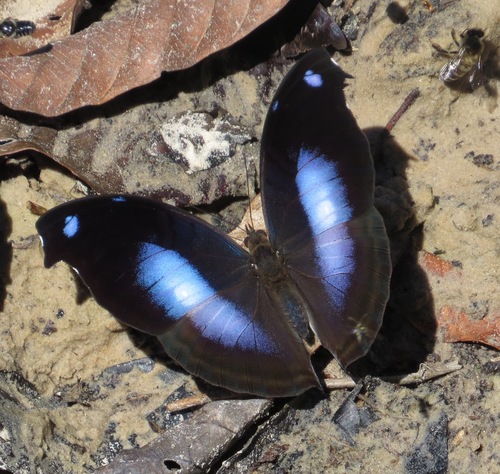
About Napeocles jucunda Hübner, 1808
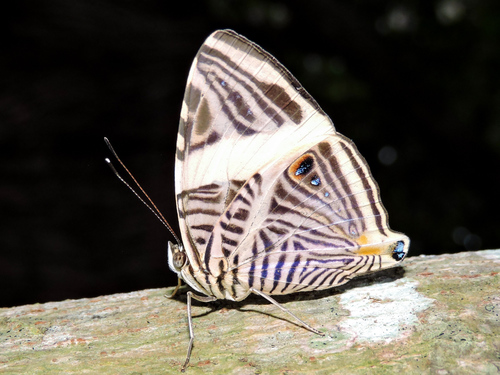
Napeocles jucunda, scientifically named Napeocles jucunda Hübner, 1808, can reach a wingspan of about 10 cm (3.9 in). These are fairly large, wide-winged butterflies with a distinct hard projection on the hindmargin of the forewings, located just below the wing tip, with a deep concavity below this projection. The hindwings are rounded in shape. The basic wing color is black or dark brown, with a broad band ranging from blue to intense white that crosses the middle of both the forewings and hindwings. The tip of the forewings also has a small blue spot. The underside of the wings is colored to resemble a wilted leaf, including a structure that mimics a central leaf vein. This species has been recorded in Peru, Bolivia, Venezuela, Brazil, and French Guiana. These butterflies live in tropical rainforest across the Amazon basin and on the eastern slopes of the Andes. They can usually be found high in the forest canopy, but sometimes they also occur on the lower foliage of trees and in humid cacao groves, around fallen fruits. The eggs and pupae of Napeocles jucunda are very similar to those of Siproeta stelenes. Final instar larvae of this species are distinguished by a dark maroon base color, with the thorax and abdomen marked by numerous yellow specks. Immature stages of Napeocles jucunda feed on plants belonging to the genus Ruellia.