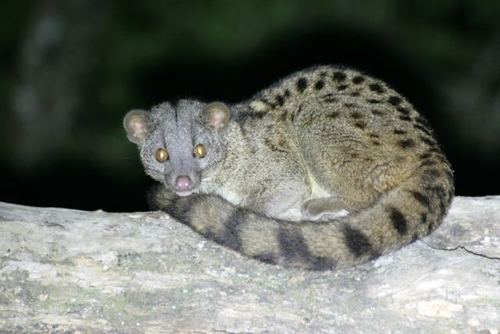
About Nandinia binotata (Gray, 1830)
Physical Characteristics
The African palm civet, scientifically named Nandinia binotata (Gray, 1830), has the following characteristics. Its fur ranges from grey to dark brown, with dark spots along its back.
Scent Glands
It has short legs, small ears, a lean body, and a long, ringed tail. It has two sets of scent glands: one on the lower abdomen, and one between the third and fourth toes of each foot. These glands secrete a strong-smelling substance that the civet uses for marking territory and during mating.
Size
Adult females have a body length of 37–61 cm (15–24 in), a tail 34–70 cm (13–28 in) long, and weigh 1.2–2.7 kg (2.6–6.0 lb). Adult males have a body length of 39.8–62.5 cm (15.7–24.6 in), a tail 43–76.2 cm (16.9–30.0 in) long, and weigh 1.3–3 kg (2.9–6.6 lb).
Ear Canal
The African palm civet's ear canal is not divided and is not cartilaginous at the end.
Range and Habitat
The African palm civet's range covers most of sub-Saharan Africa, extending from Guinea to South Sudan, south to Angola, and into eastern Zimbabwe. It has been found in deciduous forests, lowland rainforests, gallery and riverine forests, savanna woodlands, and logged forests, at elevations up to 2,500 m (8,200 ft). One wild-caught individual was recorded on Bioko Island in the 1950s, but no further individuals were recorded on the island during subsequent surveys between 1986 and 2015.
Early Records
It was recorded in Guinea's National Park of Upper Niger during 1996 to 1997 surveys. In 2000, it was observed in Senegal's Niokolo-Koba National Park, which is mainly open, grass-dominated habitat. A 2012 camera-trapping survey recorded it in forested areas of Gabon's Moukalaba-Doudou National Park.
Survey Findings
Surveys between June 2014 and May 2015 in Batéké Plateau National Park only recorded the species west of the Mpassa River. In 2013, it was sighted in the Liberian Upper Guinean forests of Gbarpolu County and Bong County.
Island Records
In 2003, it was recorded in the groundwater forest on Unguja Island, Zanzibar.
Activity and Diet
This is a nocturnal, largely arboreal mammal that spends most of its time on large branches among lianas in the tree canopy. Its diet is made up primarily of fruits, including those of the African corkwood tree (Musanga cecropioides), Uapaca, persimmon (Diospyros hoyleana), fig trees (Ficus), papayas (Carica papaya), and bananas (Musa).
Home Ranges
Males have home ranges of 34–153 ha (0.13–0.59 sq mi), while females have home ranges of 29–70 ha (0.11–0.27 sq mi). The home range of a dominant male overlaps with the home ranges of several females.
Reproduction
In Gabon, females have been recorded giving birth between September and January, which is the long wet season and the onset of the dry season. The female usually gives birth after a gestation period of 2 to 3 months. A litter can contain up to four young, which are suckled for around three months.
Lactation
While the female is suckling young, her mammary glands produce an orange-yellow liquid that discolours her abdomen and the fur of the young civets; this is thought to discourage males from mating with nursing females.
Generation Length
The African palm civet has a generation length of 7.8 years.


