About Nandina domestica Thunb.
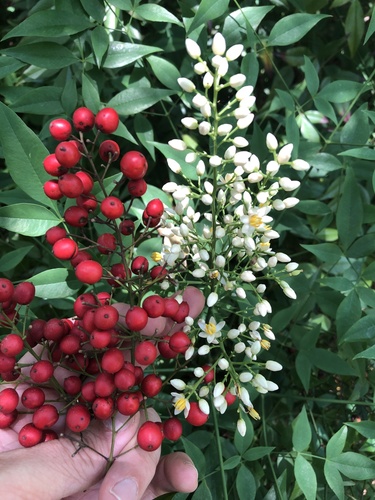
Despite its common name "sacred bamboo", Nandina domestica Thunb. is not a bamboo. It is an erect evergreen shrub that grows up to 2 m (7 ft) tall and 1.5 m (5 ft) wide, with numerous usually unbranched stems that grow from ground level. Its glossy leaves are 50–100 cm (20–39 in) long, and are bi- or tri-pinnately compound; individual leaflets are 4–11 cm (2–4 in) long and 1.5–3 cm broad. In colder regions, the leaves may sometimes be deciduous. Young spring leaves are bright pink to red before turning green, while old leaves turn red or purple again before they fall. The leaves are petiolate, 50–100 cm long, compound with two or three pinnades; leaflets are elliptical to ovate or lanceolate with entire margins, 2–10 cm long and 0.5–2 cm wide, and petioles are swollen at their bases. Inflorescences are axillary or terminally erect panicles that hold many hermaphrodite flowers. There are several pinkish-white ovate-oblong sepals, and six oblong white petals, each measuring 4 by 2.5 mm. Flowers open in early summer, growing in conical clusters held well above the foliage. The fruit is a bright red berry 5–10 mm in diameter, that ripens in late autumn and often persists through the winter. All parts of this plant are poisonous, as they contain compounds that decompose to produce hydrogen cyanide, and ingestion could be fatal. It is generally considered non-toxic to humans, but its berries are toxic to cats and grazing animals. Excessive consumption of the berries can kill birds such as cedar waxwings, which suffer cyanide toxicosis that can cause death to multiple birds at once. The berries also contain alkaloids including nantenine, which is used in scientific research as an antidote to MDMA (ecstasy). N. domestica has been cultivated in Chinese and Japanese gardens for centuries. In China, it was recorded in the Kaibao Bencao, a Song dynasty materia medica published in 973 CE. In Japan, Fujiwara no Teika mentioned it in his diary the Meigetsuki in 1230 CE, describing it being planted in the imperial garden. William Kerr brought the species to Western gardens, sending it to London in his first consignment from Canton in 1804. English breeders were uncertain of the plant's hardiness, so they initially grew it in greenhouses. The scientific name given by Carl Peter Thunberg is a Latinized version of the Japanese name for the plant, nan-ten. Over 65 cultivars have been named in Japan, where the species is very popular and a national Nandina society exists. In Shanghai, berried nandina sprays are sold on streets during New Year for decorating house altars and temples. Nandina does not produce many berries in Great Britain, but it can be grown in USDA hardiness zones 6–10, with some cultivars hardy down to zone 5. It tolerates both heat and cold, surviving temperatures from −10 to 110 °F (−23 to 43 °C). It generally requires no pruning, but can spread via underground runners and is difficult to remove completely. Spent berry stalks can easily be snapped off by hand in spring. Due to its naturally occurring toxic phytochemicals, this plant is commonly used in landscape plantings that are resistant to rabbit, deer, and javelina damage.