About Nacaduba pactolus (Felder, 1860)
This species, Nacaduba pactolus (Felder, 1860), is highly variable in both the shade of the upperside ground color, and in the width and to some extent the arrangement of the transverse white lines crossing the wings.
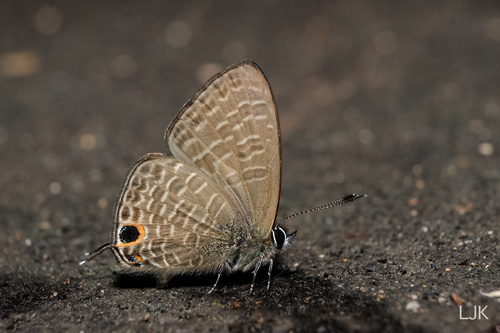
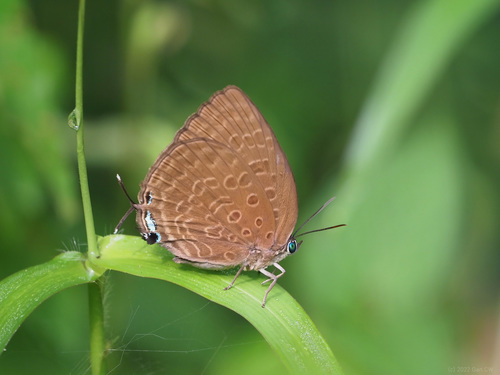
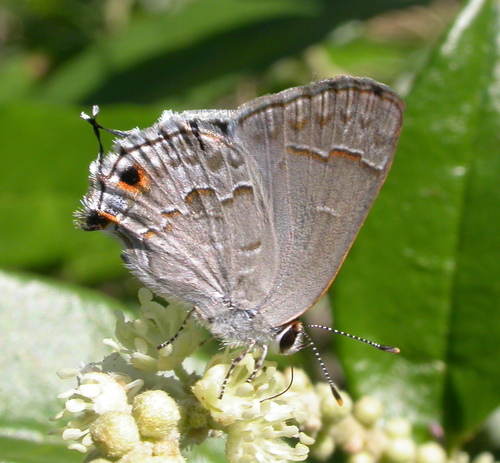
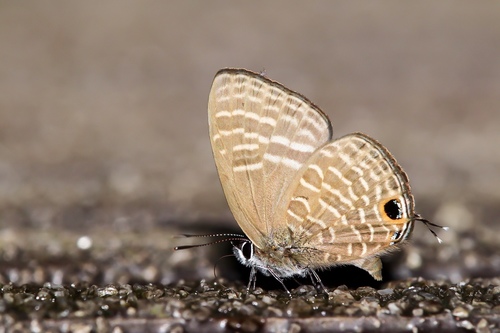
For a typical male: The upperside is deep purplish brown, with a distinct fine granular roughened texture. In certain lighting, the purple reflects iridescent blue tints. Both forewings and hindwings are uniform, and both bear thin anteciliary black lines. On the hindwing, the black tornal angle spots from the underside show through by transparency. Cilia are brownish, and the filamentous tail at the apex of vein 2 on the hindwing is black with a white tip. The underside is brown with a faint silky sheen. Both forewings and hindwings have transverse, more or less broken, thin, dull whitish bands with consistent arrangement: two short bands sit one on each side of the discocellulars; there is also a discal pair, whose posterior portion below vein 3 is shifted inward, forming the stem of a rough Y-shape, where the pair of bands along the discocellulars and the anterior portion of the two discal bands form the branches. Beyond these markings are an inner and an outer subterminal lunular line, a very thin continuous terminal line, and a jet-black anteciliary line. All of these markings are faint or obsolescent along the costa. On the hindwing, there is a subbasal pair of similar dull whitish thin bands or interrupted lines, two shorter lines one on each side of the discocellulars, and a strongly curved, highly interrupted pair of discal lines, whose portion below vein 3 is shifted inward just as it is on the forewing. Terminal markings are much the same as on the forewing but end at vein 3; posterior to this, interspace 2 holds a large round black spot, and interspace 1a holds a smaller black spot. Both spots are capped inwardly with ochraceous, edged outwardly with white, and their outer edges are sprinkled with metallic blue scales. Antennae, head, thorax and abdomen are dark brown, with a slight purple tint on the thorax. On the underside, the palpi are white mixed with black hairs that form a stiff fringe, and the thorax and abdomen are brownish white.
For a typical female: The upperside is dark brown, and the posterior two-thirds of both forewings and hindwings are glossed with iridescent purplish blue. The underside matches that of the male, but markings are more clearly defined. Antennae, head, thorax and abdomen match the male, except the antenna shafts are speckled with white.
Specimens likely belonging to wet-season broods differ in specific ways: For males, the upperside ground color is darker. The underside ground color is fuscous brown, much darker than in the typical form, and transverse white lines or bands are spaced further apart. The space enclosed between the discocellular pair and between the discal pair is darker than the surrounding ground color. On the hindwing, the white lines are medially interrupted by a very broad longitudinal fuscous-black streak that extends from the wing base to the inner subterminal transverse lunular white line. Females of wet-season broods do not appear to differ from females of the typical form.
Additional specimens, whose differences may be caused by locality or season (the original author was not able to examine a sufficient number of dated and precisely localized specimens to confirm this), appear intermediate between typical macrophthalma and typical kerriana Distant. These specimens differ from macrophthalma as follows: For males, the anteciliary black lines on both forewings and hindwings are distinctly broader and more pronounced. On the underside, transverse white lines on both forewings and hindwings are much broader, with a tendency to become diffuse and shift inward or outward, altering the overall pattern. This change is particularly noticeable on the hindwings of some specimens, where the typical pattern becomes entirely confused and lost due to additional short lunular white lines and the oblique inward or outward shifting of some of the lines that form the typical pattern. There is no abrupt change, however, and intermediate specimens connect the most aberrant forms to the typical form. Some of the examined specimens also show a tendency to develop transverse series of dark subterminal spots on the underside of the forewing, matching the pattern seen in N. kerriana Distant. Females of these intermediate specimens match the female of the typical form, but on the upperside, the iridescent blue at the wing base gradually changes to whitish on the disc and beyond the apex of the cell. On the underside, these females have broad transverse white lines matching those of male varieties.