About Nacaduba kurava (Moore)
Scientific name: Nacaduba kurava (Moore)
Male upperside: pale dull violet, with a frosted silvery sheen visible in certain lighting. Wing bases are slightly suffused with blue. The forewing has a slender anteciliary dark brown line. On the hindwing, the costa is broadly paler, and the dorsum is brownish. In most specimens, the subterminal spots in interspaces 1 and 2 show through by transparency from the underside; in a small number of specimens, these spots are marked by actual scaling. Like the forewing, the hindwing has an anteciliary dark brown line.
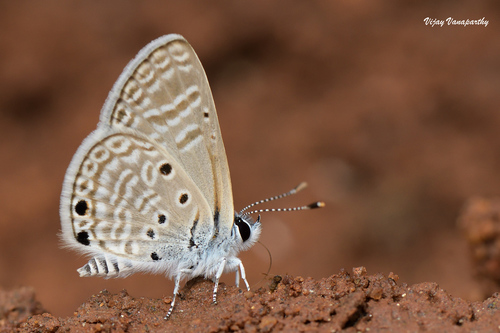
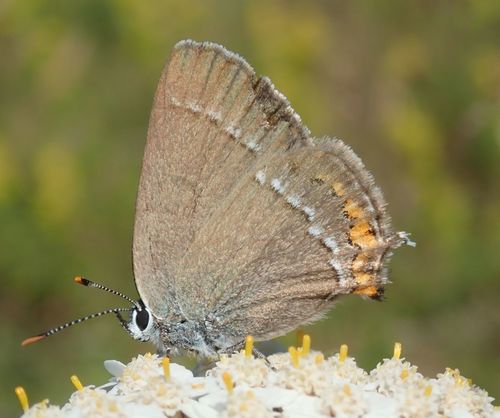
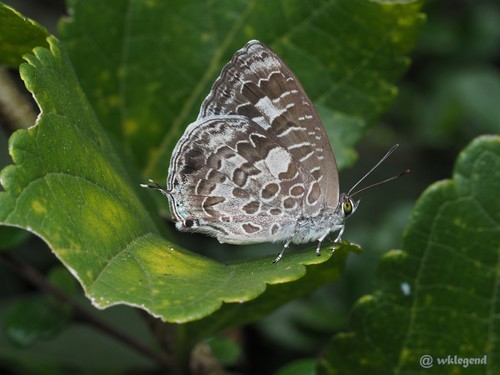
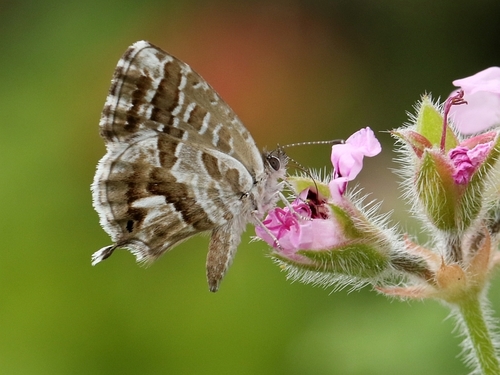
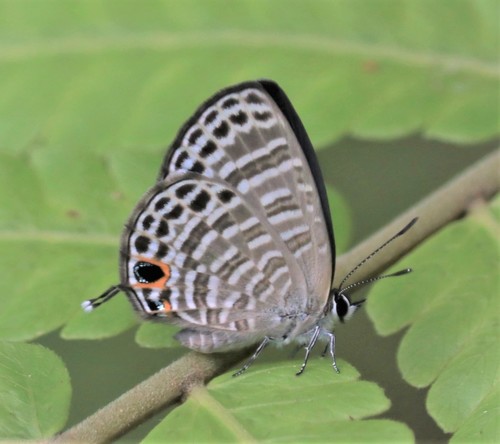
Male underside: brown. The forewing is traversed transversely by three pairs of white strigae. The innermost pair is slightly curved, running from the subcostal vein to vein 1 across the middle of the cell. The inner striga of the medial pair is complete, crossing from the subcostal vein to vein 1 on the inner side of the discocellulars. The outer striga of the medial pair crosses beyond the discocellulars from vein 7 to vein 1, and is interrupted in interspace 5. The outer pair of strigae are discal and cross from vein 7 to vein 3; the inner striga of this pair touches the outer striga of the medial pair at vein 3. After these strigae, the forewing has an inner and an outer subterminal slender lunular line, a terminal series of slender transversely linear spots edged outwardly by a very fine white line, and an anteciliary dark brown line.
On the male hindwing, there are six or seven irregular, more or less broken, sublunular white striations. Terminal markings match those on the forewing. Interspace 1 holds a minute jet-black spot, and interspace 2 holds a much larger round jet-black spot; both spots are capped inwardly with ochraceous orange and touched outwardly with glittering metallic blue scales.
Male antennae are black; the shafts have obscure white speckling on the sides. The head, thorax, and abdomen are purplish brown. On the underside, the palpi are fringed with black hairs, the thorax is bluish white, and the abdomen is white.
Female upperside: On the forewing, the costa above the cell, the very broad apex, and a terminal edging that occupies roughly one-third of the wing's length are jet-black. This black colour widens outwards along the costa. The rest of the wing is white shaded with dusky greyish, which develops a beautiful metallic blue iridescence in certain lights. On the inner side of the terminal edging is a transverse, very ill-defined, diffuse dusky band. Between this band and the black terminal edging, three somewhat prominent spots of the white ground colour are enclosed.
On the female hindwing, the costal margin above a longitudinal line running through the middle of the cell is dusky black. The posterior portion of the wing is dusky bluish, and the veins are prominently black. There is a comparatively well-defined transverse postdiscal series of black lunules, edged inwardly and outwardly by matching series of white lunules. This is followed by a subterminal series of black spots with an outer white edging, and an anteciliary jet-black line. The subterminal spots decrease in size toward the anterior; those in interspaces 2 and 3 are the largest, while the two spots in interspace 1 are minute and geminate (paired). The tail is black with a white tip.
Female underside: similar to that of the male, but the ground colour is grey with a slight brown tint. The transverse white strigae are much broader and somewhat diffuse. On the forewing, the band formed by the medial pair of strigae is much more broken than in the male, and the posterior portion below vein 3 is shifted well outwards. On the hindwing, the subterminal black spot in interspace 2 is comparatively very large and prominent. The female antenna matches the male's. The head, thorax, and abdomen are brown. On the underside, the palpi, thorax, and abdomen match those of the male.
Distribution: Sikkim; Bhutan; southern India, specifically the Nilgiri and Shevaroy Hills; Sri Lanka; Assam; Cachar; Myanmar; Tenasserim; the Nicobars; extends to the Malay Peninsula and Java; Hong Kong