About Nabalus racemosus (Michx.) Hook.
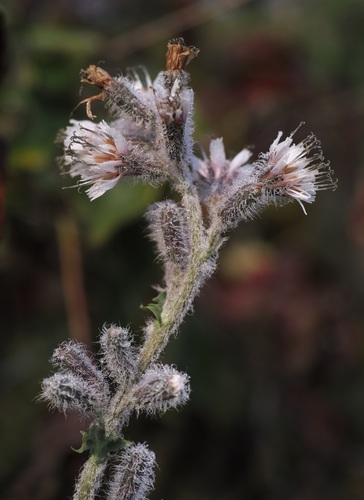
Nabalus racemosus (Michx.) Hook. is an herbaceous perennial plant that reaches 30 to 175 centimeters (1 to 5.5 ft) in height at maturity. It grows from a large, tuberous taproot that tapers at both the top and bottom. Its leaves are hairless and glaucous, coated in natural waxes that give them a pale gray or blue-green color. The lowest leaves on the plant measure 7 to 40 centimeters long and 1.5 to 10 centimeters wide. The petioles (leaf stems that connect leaves to the main plant) are extended on both sides, and leaves range in shape from oblanceolate to spatulate, meaning they resemble reversed spearheads or spoons. Basal leaves (leaves growing directly from the base of the plant) have petioles, while leaves positioned higher up the stem attach directly to the main stem and partially clasp it. Stems grow straight upward, and may be green or light purple in color. They are unbranched, hairless, and glaucous near the base, but become hispid (covered in bristly hairs) toward the top. The plant produces small pale pink to light purple flowers. Each flower head holds 9 to 25 individual flowers, which either nod or sit partially upright. The plant’s long hairs are easily visible even when it is not blooming. This species is native across much of northern North America. In Canada, it occurs in every province from Newfoundland to British Columbia, with the exception of Prince Edward Island. In the United States, its distribution in northern states is centered in the Midwest. To the west, it is native to the Rocky Mountain states of Colorado, Wyoming, and Montana, as well as Washington state. To the east, it is or was historically found in Pennsylvania, New Jersey, New York, Vermont, and Maine. It grows in water-rich habitats including stream banks, moist prairies, alpine bogs, and wet meadows. In the northern portion of its range, it is associated with calcicolous bogs.