About Nabalus boottii DC.
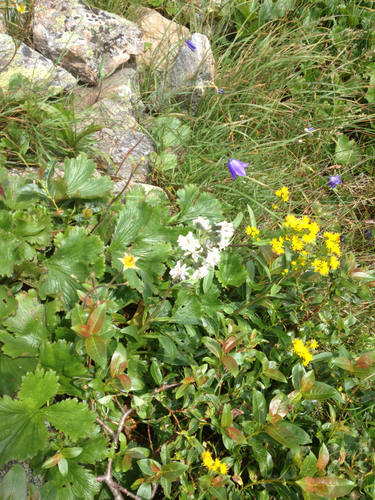
Nabalus boottii DC. is a single-stemmed herbaceous perennial that grows 5–25 cm (2.0–9.8 in) tall, emerging from short, thick taproots. Its stem may grow upright or horizontally along the ground; it is mottled purple, hairless (glabrous) at the base, and covered in dense short hairs (tomentose) near its upper end. Cauline (stem) leaves each have a 2–8 cm (0.79–3.15 in) long petiole, with ovate to triangular (deltate) blades that are 2–8 cm (0.79–3.15 in) long and 0.5–3 cm (0.20–1.18 in) wide. Basal leaves are shaped like an arrowhead with basal lobes pointing outward (hastate) or pointing backward (sagittate), with smooth entire edges or weakly toothed (dentate) margins. Flowerheads are arranged in narrow clusters of 10 to 20, with each flowerhead holding 9 to 20 white florets that are 7-13 mm long. The involucre, the structure of bracts that subtends the inflorescence, is cylindrical to bell-shaped, 10-11 mm long and 5-6 mm wide. It is made of 8 to 11 blackish-green phyllaries that are smooth, awl-shaped (subulate) to lance-shaped, and 8-12 mm long. The fruit is a light tan to yellow cypsela 5-6 mm long, marked with 7 to 10 indistinct ribs. Seeds are wind-dispersed, attached to pale yellow pappi 6-8 mm long. N. boottii flowers between July and August. This species is monocarpic, meaning it flowers and produces seed only after two or more growing seasons, and it primarily reproduces clonally. N. boottii occurs exclusively in alpine habitats above the treeline, at elevations between 1,000–1,800 m (3,300–5,900 ft), where it frequently grows alongside the related species Nabalus trifoliolatus. It has an extremely narrow range, restricted to fewer than twenty occurrences clustered in six locations across the highest peaks of New England and New York State. It grows on Boundary Bald Mountain and Mount Katahdin in Maine, Mount Washington and Mount Eisenhower in New Hampshire, Mount Mansfield and Camel's Hump in Vermont, and the highest peaks of the Adirondacks in New York. Population sizes at these sites range from more than 25,000 individuals to just a few plants. The estimated total global population is close to 130,000 individuals, with almost 90% of all individuals found near Mount Washington.