About Myscelia cyaniris (Doubleday)
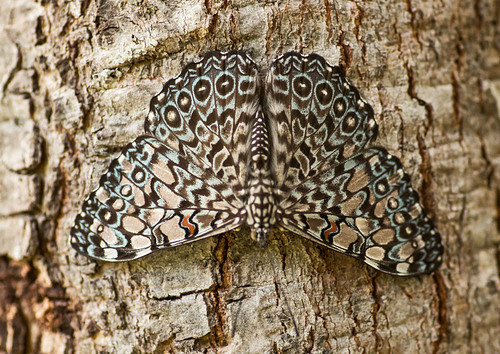
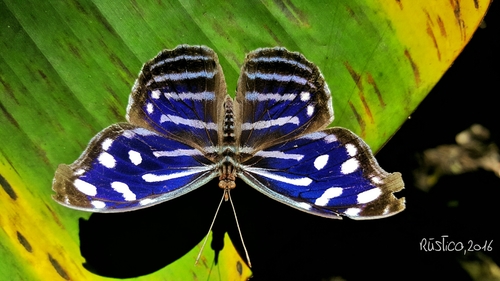
Myscelia cyaniris (Doubleday) has forewings that reach a length of about 34–36 mm (1.3–1.4 in). The dorsal sides of the upper wings are bright blue, marked with white transverse bands and white spots. The sapphire blue color of the upper wings can appear either black or neon blue depending on how light reflects off the wings. The undersides of the hindwings have cryptic coloration, mottled across different shades ranging from gray to brown. The undersides of the forewings are black with white patches. The larvae of this species feed on Dalechampia triphylla and Adelia triloba, both members of the plant family Euphorbiaceae. Adult Myscelia cyaniris usually feed on rotting fruit and animal dung. This species is distributed across Central America and northern South America, occurring from Mexico to Honduras, Costa Rica, Panama, Venezuela, Ecuador, and Peru. It inhabits Atlantic slopes from sea level up to 700 m (2,300 ft), and is associated with rainforest habitats.