About Myrsine variabilis R.Br.
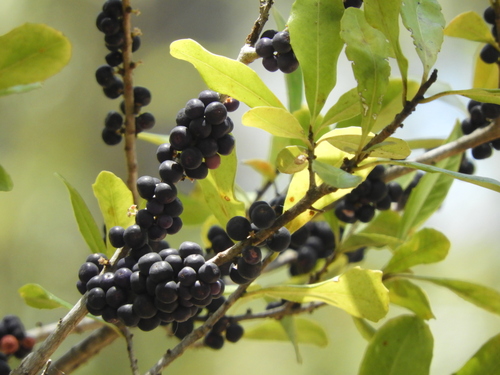
Myrsine variabilis R.Br. is a small tree that reaches around 15 metres in height, with a stem diameter up to 50 cm. It is notable for its dense, dark foliage and attractive blue fruit. The trunk is straight, mostly cylindrical, and not buttressed at the base. Its bark is grey or brown, with a somewhat corky, rough texture that features irregularities including horizontal lines and vertical cracks. Leaves are nearly sessile, with leaf stalks less than 5 mm long. Leaves are arranged alternately; young plants have toothed leaves, and all leaves have wavy edges and are relatively stiff. Leaf shape ranges from reverse lanceolate to oblong or egg-shaped, with a length of 3 to 8 cm, and usually lacks a pointed tip. Leaf veins are raised and visible on both leaf surfaces. Cream-coloured flowers grow in clusters at the ends of branches. Individual flowers are 2 mm long, borne on 4 mm long flower stalks, and flowering occurs mostly between July and August. Mature blue or violet drupes form between November and December, with a diameter of 4 to 6 mm. The fruit is eaten by Lewin's honeyeater and the rose-crowned fruit dove. Germination from fresh seed is straightforward, and removing the fleshy aril is recommended to improve seed germination success.