About Myrsine divaricata A.Cunn.
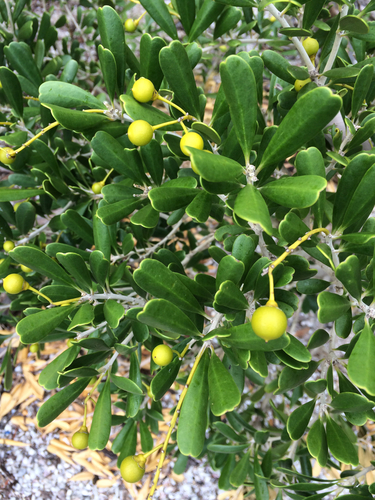
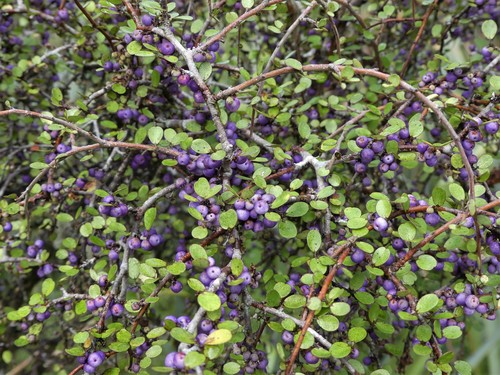
Myrsine divaricata A.Cunn. is a shrub or small tree that grows up to 4 meters tall. It has drooping, divaricating branchlets that give the plant a straggly, twiggy, highly branched appearance. Its leaves are small, measuring 5–15 mm long by 5–10 mm wide, and grow on short petioles. Leaves are simple, arranged alternately or in fascicles, most often broad-obovate or heart-shaped, with smooth margins. They have a leathery texture, are dotted with oil glands throughout, and usually bear a dark marking at the base of the leaf blade. The species has a slender trunk covered in rough, dark brown bark that is often overgrown with lichen. Its thin branchlets are divaricating, interlaced, spreading, rigid, and curve downwards to produce the plant’s characteristic drooping look. Flowers are very small, 2–3 mm in diameter, with 3 or 4 petals, and range in color from pale yellow to reddish. They grow singly or in fascicles positioned below the leaves. The fleshy fruit of Myrsine divaricata is classified as a drupe; it is small, 4–5 mm in diameter, and round. When ripe, fruits are most often bright purple, but may also be mauve, and rarely white. Each fruit contains a single round, striped seed. Myrsine divaricata is endemic to New Zealand, where it is common and widespread across the North Island, South Island, Stewart Island, Auckland Islands, and Campbell Islands. It occurs from lowland to higher montane environments, ranging from sea level up to 1,200 meters in elevation. This species is considered a habitat generalist, as it grows in a wide range of habitats throughout New Zealand, but it particularly favors sites with high fertility. It occurs from lowland to montane areas in scrubland, inland basins, forests, and on forest margins. It has a cold tolerance threshold of −8.5°C, allowing it to grow in frost hollows, areas that experience severe frosts and have poor drainage. It grows in many woody New Zealand ecosystems, including beech-broadleaved forest alliances, where it grows as a subcanopy species in silver beech-broadleaf dominated forests, as well as in beech forest alliances. Within these ecosystems, it is often used as an indicator species. Myrsine divaricata is an evergreen, dioecious species. Flowering takes place from June to November. Fruits mature a few months after flowering, between August and April, with purple fruits ripening within this same window. Its flowers are pollinated by insects, and its seeds are dispersed by frugivorous birds.