About Myrsine australis (A.Rich.) Allan
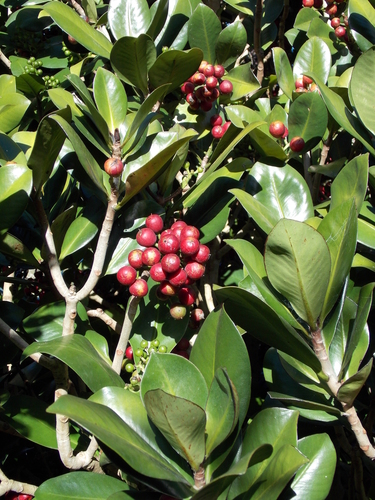
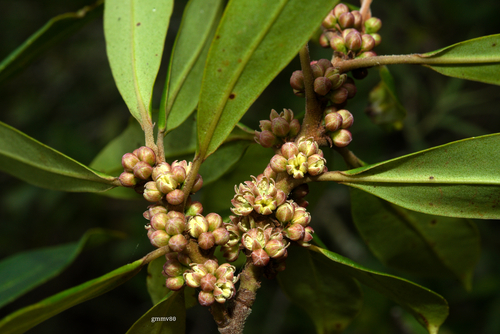
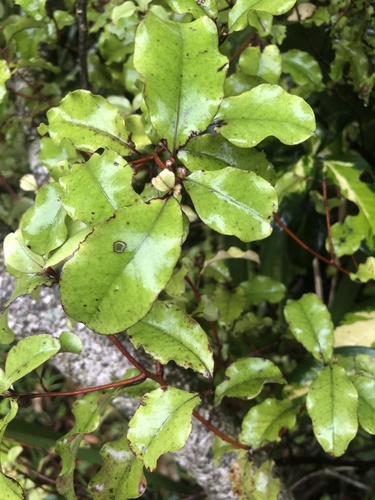
Myrsine australis, commonly called red matipo, is a small shrub or tree that grows 3–6 metres tall, with short upright branches that form a compact crown. Its trunk can reach up to 20 cm in diameter; the bark of the trunk and older branches is dark brown to black, while young juvenile branches are reddish, a key distinguishing feature of the species. The top surface of its leaves is pale green with a yellow tinge, and the underside is an even paler shade of this color. Leaves measure 3–6 cm in length and 1.5–2.5 cm in width, are arranged alternately along stems, and have a leathery texture. Leaf margins are typically wavy, though uncommon flat-margined forms also exist. Each leaf blade is usually covered in round, translucent glands, and connects to a red leaf stalk (petiole) that is roughly 5 mm long. Petiole color and size can vary based on environmental conditions and local population differences. Red matipo is native to the North, South and Stewart Islands of New Zealand, and is more abundant in northern parts of the country. Alongside four other Myrsine species native to the North, South and Stewart Islands, four more Myrsine species are native only to New Zealand’s outlying islands: the Chatham Islands, the Three Kings Islands, and the Kermadec Islands. Outside of New Zealand, there are an additional 300 Myrsine species found across the world. Red matipo occurs naturally throughout the North, South and Stewart Islands. It was once common across all of lowland New Zealand, an area that was largely made up of podocarp/broadleaf forest. Much of this habitat has been cleared for activities like timber milling and agriculture, so the existing area occupied by the species is far smaller than it once was. Today, red matipo is commonly found in revegetation projects and riparian planting areas across the country, and is grown by gardeners who value it for its aesthetic appeal and its useful properties as a hedge plant. Pine plantations cover a large area of New Zealand, often on steep, erosion-prone land, and red matipo is one of several native New Zealand plants that regularly persists growing under pine tree canopies. Red matipo grows from sea level up to 900 m in elevation. It prefers forest margins, scrubland, and coastal forest, and only rarely grows as part of the understory in mature inland forest. It acts as an early colonizer when formerly used land like agricultural fields are abandoned and natural regeneration begins, as long as a seed source is available. Because of this, it is recognized as a hardy species that is often used in planted revegetation sites to provide initial cover for the establishment of longer-lived, less hardy plants. Due to its wide ecological and geographic distribution, red matipo grows alongside a wide variety of other plant species: it grows with pōhutukawa, ngaio, and titoki on the coast; with mānuka and kānuka in scrubland; with podocarps in mature forest; and in lower altitude beech forests. This species is common, and is not considered threatened or at risk of extinction. On average, Myrsine australis flowers between August and January, and produces fruit between September and December. Its flowers grow in clusters on small stalks on branchlets where older leaves have already fallen. The flowers are small and inconspicuous, just like most other New Zealand native flowers, measuring 1.5mm to 2.5mm in diameter. They are cream to whitish in color and covered in small orange glands. The flowers are unisexual, meaning some individual plants produce only male flowers for pollen distribution, while other individuals produce only female flowers for fertilization and fruit development. Flower petals are lanceolate, obtuse, free, and revolute. Because flowering and fruiting periods overlap, some individual plants can have both fruit and flowers at the same time. The fruits of red matipo are drupes: a single seed is enclosed in a hard core, which is then covered by a fleshy outer layer. Fruits measure 2–4 mm in diameter, are dark brown to black in color, and are most commonly dispersed by kererū, tūī, tauhou, korimako, and blackbird. These birds eat the fruit and excrete the seed after digestion. The species can maintain a seed bank: some seeds stay dormant for a year or more and germinate at random intervals and in varying quantities. Seeds generally require a chilling period to germinate, and it is suspected that embryos may still continue to develop after seed fall. Because of these factors, germination takes nearly four to five times longer than it does for other New Zealand native species such as Hoheria angustifolia and Coprosma foetidissima, which germinate much more quickly. These germination time frames are rough averages, as each individual Myrsine australis plant has natural variation and an irregular germination pattern.