About Myrmica ruginodis Nylander, 1846
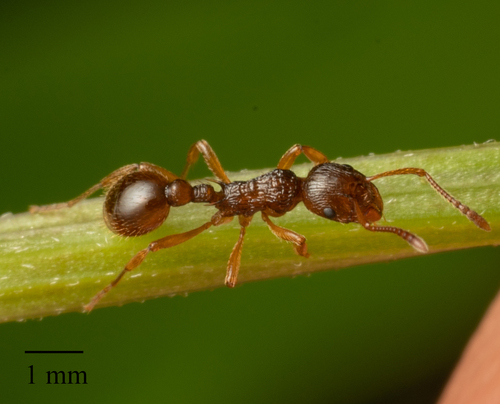
Myrmica ruginodis Nylander, 1846 closely resembles Myrmica rubra, another common ant species widespread across much of Eurasia. The two species can be distinguished by two key features: the shape at the base of the antennae, which is curved in M. ruginodis and sharply angled in M. rubra, and the length of spines that project from the back of the thorax. In M. ruginodis, these spines are as long as the distance between their tips, while they are shorter in M. rubra. Myrmica ruginodis is distributed across the northern Palaearctic region, where it occurs at higher altitudes and latitudes than M. rubra. Its range stretches from Western Europe to Japan, extending south to Italy and north to the Norwegian North Cape. It is the only ant species recorded from all vice-counties of the British Isles (used for biological recording), including the Channel Islands, and it is the only ant species found in Shetland, where it is locally common. It is very abundant in European woodland and moorland, especially at altitudes above 1,000 metres (3,300 ft), where it replaces M. rubra. The diet of M. ruginodis is usually made up of small insects and other arthropods, but it may also include any bird or mammal carcasses encountered while foraging. Myrmica ruginodis overwinters in the larval stage. Larvae that have experienced winter cold temperatures can develop into either workers or queens, and caste specialisation only happens around one week before the end of larval growth. A queen lays eggs consistently throughout spring and summer, and these eggs produce two groups of larvae that develop at different rates. The faster-developing brood matures within three months and becomes workers; the slower-developing brood takes a full year to develop, overwinters as larvae, and then grows into queens or workers. A single M. ruginodis colony holds between 1,200 and 2,500 individuals, including 10 to 20 queens. Mating flights occur in July and August.