About Myrmecocystus mexicanus Wesmael, 1838
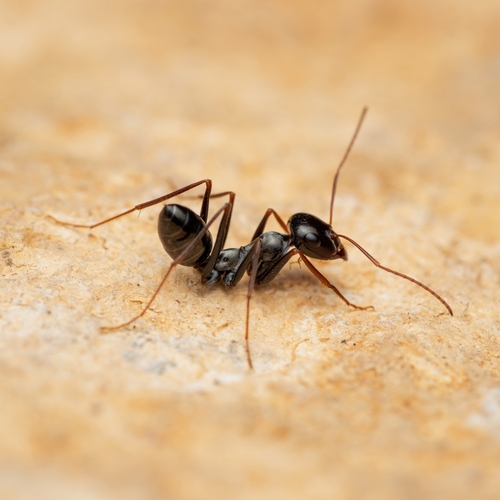
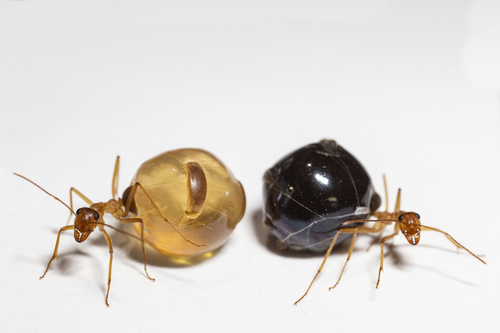
Myrmecocystus mexicanus Wesmael, 1838 has distinct size and color traits across different castes. Worker individuals range from 3 to 7 mm in length. They have a light tan thorax and legs, a slightly darker head, and black mandibles, with a brownish-gray gaster. Queen individuals are roughly 9 mm in length, with reddish brown head and mandibles, yellowish brown thorax, a lighter yellow gaster, and dull yellow legs. Male individuals are typically about 6 mm long, and are winged. They have a small black head and black thorax, with the exception of a reddish-brown pronotum, a dark brown gaster, and gray legs. A specialized caste called replete workers have functionally enlarged crops for food storage. When a replete worker is fully filled with food, its crop swells and displaces other abdominal organs, expanding to four to five times its original normal linear dimension. The abdomen of a replete M. mexicanus worker ranges from 6 to 12 mm in length. When repletes are drained of their stored food, they become what are called "flaccid depletes". Repletes of M. mexicanus vary in the food content they carry, and can be grouped by the color of their distended abdomens into four classes: dark amber, amber, milky, and clear. Each of these colors is thought to correspond to a specific food source. Dark amber and amber repletes store sugars including glucose and fructose, which most commonly come from flower nectar. Milky repletes store large amounts of protein and oils, which are believed to come from insect prey. Clear repletes store mostly water and sucrose, so they are thought to function as water storage for the arid climate the species occupies. A 1974 study by Burgett & Young found that a small percentage of repletes have two visible layers of liquid in their crops: one layer made of sugars, and the other made of lipids, glycerol, and cholesterol esters. In degraded grassland habitats in southern Arizona, M. mexicanus colonies have an average lifespan of 8.9 years, with a maximum recorded lifespan of 23 years. Only two castes in M. mexicanus colonies are able to reproduce: queens and males. Workers are sterile, and their role is to care for the queen and colony brood. Mating takes place during nuptial flights, when winged queens and males swarm outside of the nest. M. mexicanus collects most of its food from nectar from Yucca glauca yucca plants, and sugary galls that form on Quercus gambelii scrub oaks. These galls, which are round growths on scrub oak branches, are formed by the gall wasp Holcaspis perniciosus, and leak a clear sugary liquid that the ants feed on. In addition to these main sources, the ants also feed on a variety of other flower nectars, cacti fruit, and the excretions of aphids that feed on yucca plants. Worker ants also collect dead insects and attack small, soft-bodied insects. In particular, M. mexicanus feeds on dead and dying western harvester ants Pogonomyrmex occidentalis.