About Myrmecia regularis Crawley, 1925
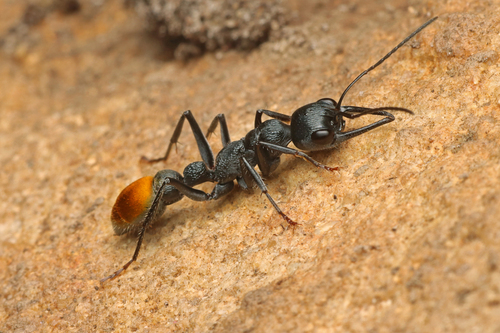
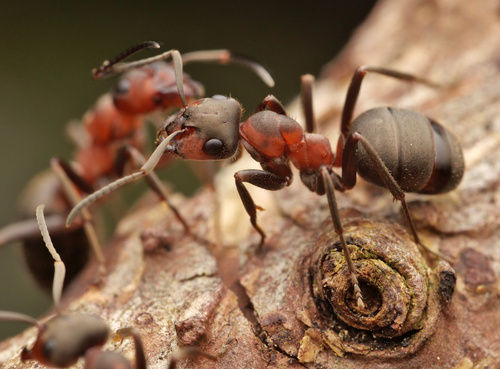
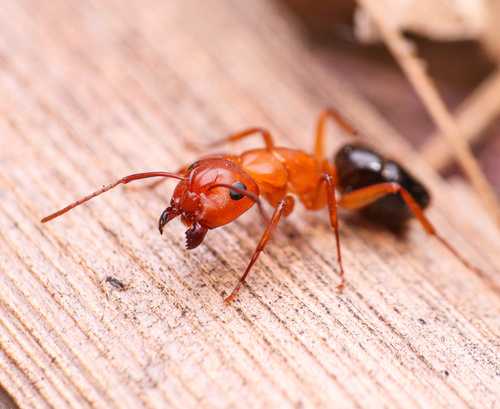
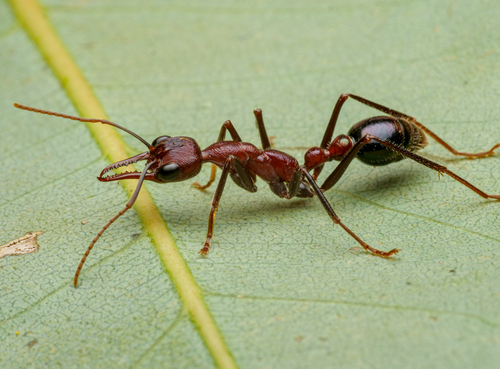
For Myrmecia regularis Crawley, 1925, worker body length (excluding mandibles) measures 10 to 14 millimetres (0.4 to 0.6 in), while mandibles alone measure 3.6 millimetres (0.1 in). When including mandibles, workers measure 14 to 20 millimetres (0.6 to 0.8 in); queens measure 18 to 20 millimetres (0.7 to 0.8 in), and males measure 15 to 17 millimetres (0.6 to 0.7 in). These ants are bright brownish-red overall, with brown legs and scapes, and a black gaster. The entire head and thorax are bright mahogany red, and mandibles are shaded with brown. Body hair is yellow, moderately long, and erect, covering the whole body; hairs are shorter on the legs and completely absent on antennae. Soft short pubescence is only found on the clypeus. Queens share the same colour variation, body sculpture, and pilosity as workers, but are typically larger. Queens have reduced thoracic development, and Clark described them as "subapterous", meaning wings are only present as undifferentiated wing buds. However, queens collected from Manjimup have fully developed wings. The head, epinotum, mesonotum, and pronotum are finely striate-rugose. The head is as long as it is broad, with a straight occipital border. Mandibles are slightly shorter than the head, with a concave border. The pronotum is one-third broader than its total length; the mesonotum is one-sixth broader than long, almost circular in shape and clearly convex. The epinotum is also slightly broader than long. The gaster is slightly broader than long, and the postpetiole is one-fifth broader than long. The scutellum is oval and almost twice as broad as long. Male specimens are rarely collected, and all available specimens are too badly damaged for a full proper examination. The colour and pilosity of males and workers show little to no difference. The heads of both workers and queens are as long as broad, with convex sides. Mandibles are long, with 13 recorded teeth. The first and third segments of the funiculus are equal in length. In workers, the thorax is two to three-fourths longer than broad, and the mesonotum is longer than it is broad; in queens, the mesonotum is broader than it is long. The node (a segment between the mesosoma and gaster) is as long as it is broad, and the postpetiole is one-sixth broader than long. The first segment of the gaster is broader than its length. M. regularis looks similar to M. forficata, but can be distinguished by several morphological differences. Due to the rugose sculpture of the head and thorax, M. regularis is noticeably smaller than M. forficata. It also has much narrower mandibles, more rounded posterior head corners, and a longer petiolar peduncle. Its mandibles are deep red, and some areas such as gastric segments are golden brown. Myrmecia regularis is native to south-western coastal regions of Australia. Confirmed nest locations include the towns of Albany, Denmark, Nornalup, Manjimup, Pemberton, and areas around the Margaret River in south Western Australia; Kangaroo Island in South Australia; and Portland in Victoria. This ant occupies a range of rural habitats, including woodland, open forests, dry marri forests, tree heath, and granite mountains. It is a dominant species in Eucalyptus woodland, particularly in areas with E. diversicolor, E. gomphocephala, and E. marginata trees. M. regularis colonies do not build mounds; instead, they nest in damp black soil or under large stones and logs. Colonies contain 100 to 200 workers, and are typically found at altitudes between 80 and 350 m (260 and 1,150 ft) above sea level. Excavated incipient (young, developing) nests have small chambers 2.5 to 4 cm (0.98 to 1.57 in) wide, with logs or stones forming the chamber roof. The ground inside the chamber is flat, with continuous walls on all sides; outer walls are thin because the nest is located near the edge of a log or stone. Most nests have a gallery that extends further into the ground, usually around 6 cm (2.4 in) deep, ending in a smaller, more irregular chamber. Myrmecia regularis is a highly aggressive ant. If its nest is disturbed, workers will chase any intruder up to 1.8–2.7 metres (2–3 yards) away. Its stings are very painful and particularly powerful. In some cases, humans stung by M. regularis have developed an allergy to its venom. In a 2011 study of ant sting anaphylaxis causes in Australia, 265 out of 376 human participants reacted to stings from several Myrmecia species. Of these reacting participants, nine serum samples tested IgE positive for M. regularis venom. These ants are active both diurnally and nocturnally. They forage on the trunks of Eucalyptus trees to feed on sap and nectar, or capture small insects such as caterpillars and ants in the genus Camponotus or subgenus Orthocrema. Larvae are carnivorous and feed exclusively on insects, consuming either small portions or the entire insect. Unlike most Myrmecia species, trophallaxis occurs between adults, and between adults and larvae. All life stages of the frog Metacrinia nichollsi live inside M. regularis colonies, using galleries constructed by the ants. The parasitic ant M. inquilina may attempt to enter M. regularis nests to establish its own colonies, but M. inquilina queens are typically seized and killed immediately when the two species come into contact. Nuptial flight does not occur before February. This is supported by the observation that larvae spin cocoons by November, and these cocoons cannot produce adult workers or reproductive males and females by January. Queens are most likely fertilised by males between February and April; alates have been observed engaging in nuptial flight during March. Before leaving the parent nest, queens shed their wings inside the nest and mate with low-flying males nearby. After nuptial flight, a queen isolates herself and forms a small underground chamber, where she remains for seven to eight months. Scientists consider it unlikely that a queen can survive this long on her stored fat and wing musculature alone. During this waiting period, queens may emerge from their nest occasionally, but only lay eggs from October to November, when food is abundant. Despite this general pattern, some queens lay eggs just one month after isolation during winter. M. regularis is semi-claustral, meaning queens leave the nest to forage to feed their young. Queens emerge from their nest from time to time, capturing insects for their larvae or feeding on sweet substances. If deprived of food, a queen will rely on her own fat stores to support larvae until she dies or finds new food. Larvae are not cannibalised, and remain alive for up to a week after the queen's death. An individual ant takes eight months to develop from an egg to an adult.