About Myrmecia pilosula Smith, 1858
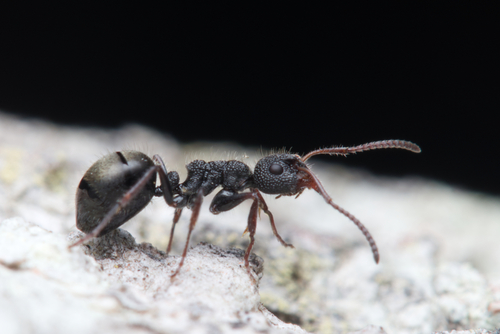
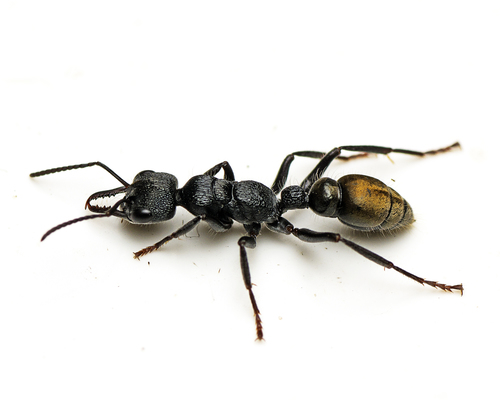
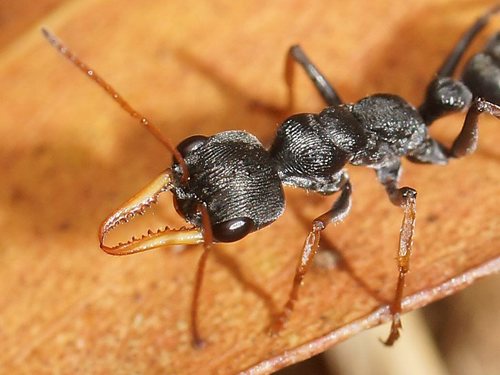
Myrmecia pilosula, commonly called jack jumper ants, share traits with their close relatives: they have a powerful sting and large mandibles. Their body color can be black or blackish-red, with yellow or orange legs; their antennae, tibiae, tarsi, and mandibles are also yellow or orange. Compared to other species in the Myrmecia genus, this ant is medium-sized. Worker individuals are typically 12 to 14 mm (0.47 to 0.55 in) long, and this measurement drops to 10 mm (0.39 in) when mandibles are excluded. Their mandibles are long and slender, measuring 4.2 mm (0.17 in), and are concave along the outer border. The ant’s body hair (pubescence) is greyish, short, and erect; it is longer and more abundant on the gaster, entirely absent from the antennae, and short and suberect on the legs. For male ants, pubescence is grey and long, and abundant across the entire body, though it becomes shorter on the legs, and pubescence on the male gaster is white and yellowish. Large, shallow punctures (tiny dots) are easily visible on the head, while the thorax and node have irregular punctures. Queen jack jumpers look very similar to workers, but have a more irregular, coarser mesosoma (middle body segment). Queens are the largest caste, measuring 14 to 16 mm (0.55 to 0.63 in) in length. Males are either smaller than workers or around the same size, ranging from 11 to 12 mm (0.43 to 0.47 in) long. Males have much smaller, triangular mandibles compared to workers and queens, with a large tooth positioned at the center of the inner border, between the base and apex.
Jack jumper ants are abundant across most of Australia and are one of the most commonly encountered bull ant species. In Western Australia, they are found on the south-western tip, recorded in sand hills around Albany, Mundaring, Denmark, and Esperance, and are rarely sighted in the state’s northern regions. In South Australia, they are common in the south-east, frequently encountered at Mount Lofty (especially the Adelaide Hills), Normanville, Hallett Cove, and Aldgate, and do not occur in the state’s north-western regions. Dense populations live on the western seaboard of Kangaroo Island. The species is widespread across the whole of Victoria, though it is uncommon in Melbourne; populations have been collected from the Melbourne suburb of Elsternwick, and jack jumpers are commonly found in the Great Otway Ranges, with many nests observed around Gellibrand. In New South Wales, nests occur throughout the entire state except for north-western New South Wales, with dense populations mostly located in the Snowy Mountains, Blue Mountains, and coastal regions. Jack jumpers are widespread in the Australian Capital Territory. In Queensland, they are only found along the state’s south-eastern coastlines, with frequent populations in the Bunya Mountains, Fletcher, Stanthorpe, Sunshine Coast, Tamborine Mountain, and Millmerran, and have been recorded as far north as the Atherton Tablelands. The species lives across all of Tasmania, where it is widespread, dense in higher mountain regions, and confirmed to occur on King Island (north-west of Tasmania). Their presence in the Northern Territory has not been verified. Jack jumpers occupy open habitats including damp areas, forests, pastures, gardens, and lawns, and prefer fine gravel and sandy soil. Colonies are also found in open light bushland. Their preferred natural habitats are woodlands, dry open forests, grasslands, and rural areas, and they are less common in urban areas. They have been recorded in dry sclerophyll forests, at elevations ranging from 121 to 1,432 m (397 to 4,698 ft), with an average elevation of 1,001 m (3,284 ft). Nests are mounds constructed from finely granular gravel, soil, and pebbles, measuring 20 to 60 cm (8 to 24 in) in diameter and reaching up to 0.5 m (20 in) in height. Two nest forms have been documented: a simple nest with a distinct internal shaft, and a complex structure surrounded by a mound. The ants decorate their nests with dry materials that heat quickly to capture the sun’s warmth, using materials including seeds, soil, charcoal, stones, sticks, and even small invertebrate corpses. They also camouflage nests with leaf litter, debris, and long grass. Nests may be hidden under rocks (where queens most often found new colonies) or around small gravel piles. In Tasmanian suburban areas, jack jumpers live in native vegetation and build nests in rockeries, cracks in concrete walls, dry soil, and grass. Studies have recorded jack jumper populations in Tasmanian suburbs with extensive vegetation cover such as Mount Nelson, Fern Tree, and West Hobart, while they are absent from heavily urbanised suburbs like North Hobart and Battery Point. Like other regional ant species, their range across southern Australia appears characteristic of a relict species. Rove beetles of the genus Heterothops generally live in jack jumper nests and raise their brood within nest chambers, and skinks have been found in some nests. Several chemical control methods are effective against jack jumper ants for pest management: chemicals including bendiocarb, chlorpyrifos, diazinon, and permethrin work well, spraying Solfac into nests successfully controls colonies near high-traffic human areas, and pouring carbon disulfide into nest holes and covering the entrance with soil is another method of removing colonies. The Australian National Botanic Gardens uses an effective strategy of marking and maintaining jack jumper nests.
Jack jumper ants are primarily diurnal: worker ants forage during the day until dusk. They are active in warmer months and become dormant in winter. Fights between workers from the same colony are not uncommon. They are known for aggression toward humans, attraction to movement, and well-developed vision, able to observe and follow intruders from 1 metre (1.1 yards) away. The species is a skilled jumper, with leaps between 51 and 76 mm (2 to 3 inches). When disturbed, their jumping behaviour led William Morton Wheeler to compare jack jumper ants to "Lilliputian cavalry galloping to battle"; he also noted that they appear ludicrous as they emerge from their nests in a series of short hops. It has not been confirmed whether this species produces alarm pheromones, though the closely related Myrmecia gulosa uses pheromones to trigger territorial alarm; if jack jumpers do produce alarm pheromones, this would explain their ability to attack in large groups. Foraging workers are regularly seen on the inflorescences of Prasophyllum alpinum, a plant that is mostly pollinated by ichneumonid wasps. While pollinia are often found in the ants’ jaws, the ants clean their mandibles on the leaves and stems of nectar-rich plants before moving to a new flower, which prevents pollen exchange. It remains unknown whether jack jumper ants contribute to pollination.
Like all ants, jack jumper ant development begins from an egg. Fertilised eggs develop into diploid females, while unfertilised eggs develop into haploid males. They undergo complete metamorphosis, passing through larval and pupal stages before emerging as mature adults. Isolated cocoons can shed their pupal skin prior to hatching and reach full pigmentation without assistance, and pupae can eclose (emerge from the pupal stage) with no help from other ants. Newly emerged adult jack jumper ants can immediately identify their distinct tasks, a primitive trait common to all Myrmecia ants. Observations of six worker ants found their average life expectancy is around 1.3 years, ranging from as little as 1.12 years to 1.6 years, which equals a lifespan of 401 to 584 days, with an average of 474 days. Queens live far longer than workers, reaching 10 years of age or more. In laboratory colonies, eggs are commonly found clumped together. Worker ants carry these clumps, which hold between 2 and 30 eggs with no larvae to hold the cluster together; this confirms that jack jumper ant eggs do not always occur singly. In 1971, George C. Wheeler and Jeanette Wheeler studied and described larvae collected from New South Wales and South Australia. They noted very young jack jumper larvae measure 2.4 mm (0.094 in) long and have two types of body hair. Young larvae, which develop from very young larvae, measure 2.7 mm (0.11 in) long and share similar body characteristics with mature larvae, which reach 12.5 mm (0.49 in) long. Jack jumper queens are polyandrous, meaning a single queen can mate more than once. Queens mate with between one and nine males during a nuptial flight, and the effective number of mates per queen ranges from 1.0 to 11.4; most queens only mate with one or two males. As the number of available male mates increases, the number of effective matings per queen decreases. Colonies are polygynous, meaning a single colony can house multiple queens. Most colonies contain one to four queens, and egg-laying queens in multiple-queen colonies are unrelated to one another. One study found 11 out of 14 tested colonies (78.57%) were polygynous, confirming this is a common trait for the species. After mating, queens hunt for food to feed their first brood when establishing a new nest, a reproductive strategy called semiclaustral colony foundation. Colonies can hold as few as 500 ants, or as many as 800 to 1,000 ants; excavated wild nests typically hold between 34 and 344 individuals. Jack jumper ant workers are gamergates, meaning they can reproduce whether a queen is present in the colony or not. While colonies are mostly polygynous with polyandrous queens, the level of polyandry in jack jumper colonies is low compared to other Myrmecia species, though it is similar to levels seen in M. pyriformis. In 1979, Craig and Crozier investigated the genetic structure of jack jumper ant colonies, and found that while queens in the same colony are usually unrelated, related queens can occasionally coexist in a single colony. It has been suggested that jack jumper queens may sometimes use dependent colony foundation, though independent colony foundation also occurs, as queens have fully developed wings and can fly. Isolation by distance genetic patterns have been recorded: nests that are closer to each other are more genetically similar than nests that are farther apart. Because closer nests are more genetically similar, independent colony foundation via nuptial flight is most likely when queens disperse far from their genetically similar natal colony. When suitable sites for independent colony foundation are limited or unavailable, inseminated queens may seek adoption into unrelated alien colonies, an observation that supports the nest-site limitation hypothesis. After nuptial flight, some queens may attempt to return to their natal nest but end up joining a different nearby nest, which tends to be genetically similar to their birth nest due to the species’ isolation by distance pattern.