About Myrmecia nigriceps Mayr, 1862
Myrmecia nigriceps worker ants range in size from 19 to 23 millimetres (0.75 to 0.91 in). Colonies also contain very small workers that are usually less than half the size of typical workers. It has not been confirmed that M. nigriceps is polymorphic, because there is little morphological difference between workers of different sizes, unlike Formicinae ants and Pheidole, where soldiers have distinctly enlarged heads. Queens are the largest caste, measuring around 24 to 26 millimetres (0.94 to 1.02 in), while males are similar in size to workers at 18 to 20 millimetres (0.71 to 0.79 in).
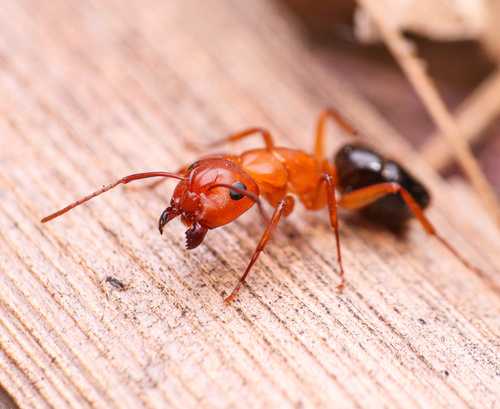
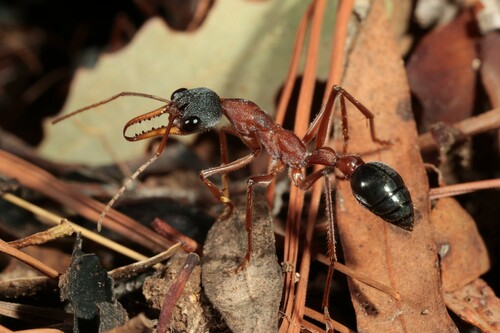
The head and gaster of M. nigriceps are black; the thorax, node, and postpetiole are either red or yellowish red; and the antennae and legs are either yellow or testaceous. The mandibles and clypeus are also yellow. Body hair is short and yellow, erect on the body and suberect on the legs. Pubescence (short, fine, soft hair) is white and abundant across the postpetiole and gaster. The worker head is almost as broad as it is long; worker mandibles are longer than the head and have 13 teeth. Queens resemble workers in general appearance, but are the largest colony members, have more abundant hair, a broader head, and shorter, broader mandibles that are still as long as the head. Queen wings are yellowish and translucent. Males are the smallest colony members and are easily identified by their distinctly smaller mandibles. They have longer, more abundant hair than workers and queens, and a long, broad head.
Myrmecia nigriceps is similar in appearance to M. vindex, but can be distinguished by several morphological traits: M. nigriceps is generally larger, its worker head is black or dark brown, broader, and more rectangular, and its thorax and pedicel are noticeably darker and brownish red. The nesting habits and behaviour of the two species are similar.
Myrmecia nigriceps is distributed across most of Australia, but is absent from central Australia and the northern Australian coast. Its range extends from Queensland south into New South Wales, the Australian Capital Territory, and Victoria, and it is also found in South Australia and Western Australia. Colonies occur in deserts, coastal areas, plateaus, woodland, native vegetation, hot hilly areas covered with scrubby vegetation, and rehabilitated sites, at elevations from 300 to 460 metres (1,000 to 1,500 ft). M. nigriceps constructs mound nests, though colonies may also nest under logs. Workers decorate the nest with lateritic pebbles, soil crumbs, small stones, and plant material, in a pattern similar to that of meat ant (Iridomyrmex purpureus) nests.
Myrmecia nigriceps workers forage during crepuscular and nocturnal hours. They forage on Eucalyptus trees and are sympatric with many other species. Adult ants are nectarivores, feeding on sweet liquids from plants, while larvae are carnivorous, feeding on captured invertebrates and other ants such as Camponotus workers and males. Two cockroach species, Platyzosteria castanea and Platyzosteria ruficeps, can repel attacks by M. nigriceps by releasing a secretion that disorients attacking workers. Workers begin foraging one hour before sunset, with peak activity during twilight. These ants have excellent vision, with larger eye lenses and photoreceptors than any other Myrmecia ant. They can distinguish the distance and size of objects moving nearly a metre away, are sensitive to motion, and will rapidly charge and attack any moving object. Predators of M. nigriceps include the short-beaked echidna (Tachygloxxxx aculeatus) and spiders in the genus Zenodorus, particularly Zenodorus metallescens. Blindsnakes are known to eat M. nigriceps larvae and pupae. M. nigriceps colonies also act as hosts for the social parasite M. inquilina, which lays its eggs inside host colonies.
Myrmecia nigriceps is an extremely aggressive ant, and larger colonies may match the fierceness and pugnacity of other Myrmecia species such as M. gulosa. While its mandibles cause little to no pain in humans, the ant has a painful, powerful sting at the end of the gaster. Like the stings of other ants, this sting is not barbed, so workers can sting multiple times without injuring themselves. The venom has a median lethal dose (LD50) of 7.3 mg/kg, which makes it relatively weak compared to venom from other Myrmecia ants, which have much lower LD50 values. A 2011 study recorded at least one patient with an allergic reaction to M. nigriceps venom, and also concluded that many other Myrmecia species, as well as the green-head ant (Rhytidoponera metallica), can cause anaphylaxis. On the four-point Starr sting pain scale, which compares the overall pain of hymenopteran stings, the M. nigriceps sting ranks as two, described as "painful".
M. nigriceps workers can enter unrelated colonies without being attacked; this may happen because the ants fail to recognize non-nestmates, or because the consequences of ignoring non-nestmate workers are low. Nuptial flight occurs for several days after rain, between December and March. Males and virgin queens emerge from the nest, and unlike ant species that mate on the ground or climb to nearby trees and branches before taking flight, M. nigriceps reproductive alates take flight directly from the nest. Recorded nuptial flights usually take place on hilltops. Unlike some other Myrmecia species such as M. regularis, M. nigriceps queens do not seal the nest entrance during colony foundation. M. nigriceps workers have an exceptionally long average lifespan of 2.2 years, with recorded maximum longevity ranging from 2.1 to 2.4 years.