About Myrmecia esuriens Fabricius, 1804
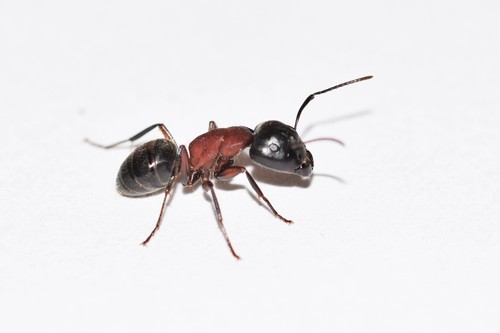
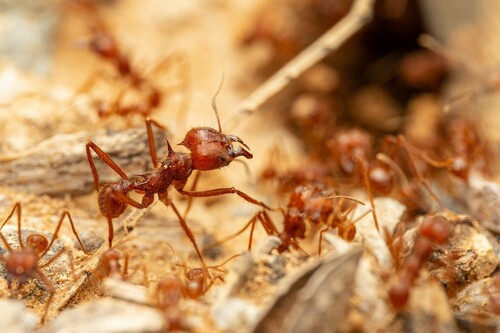
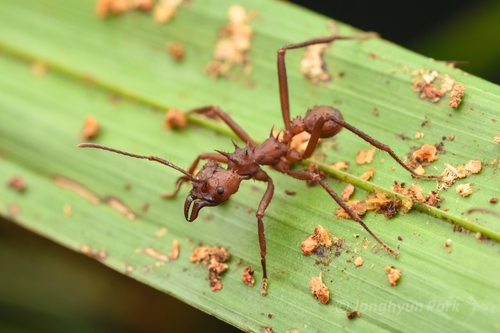
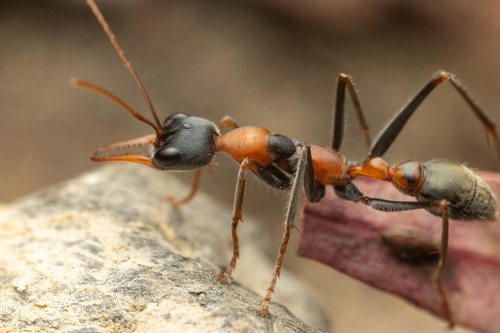
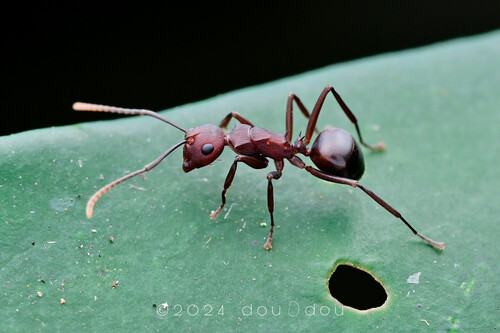
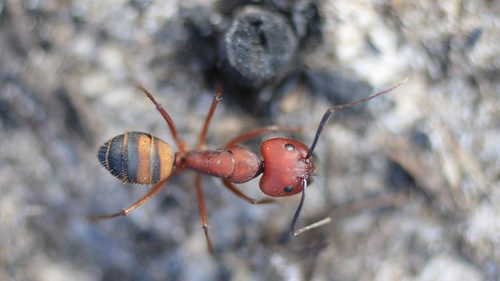
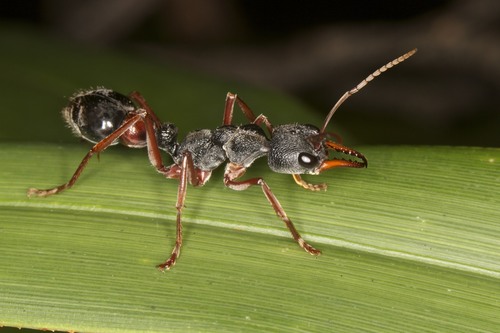
Myrmecia esuriens, commonly known as the Tasmanian inchman, is a bull ant species first described by Fabricius in 1804. In terms of morphology, the largest individuals of this species are queens, which measure 22 to 24 mm (0.87 to 0.94 in) in length. Males (drones) grow to 16 mm (0.63 in) long, and worker ants average 14 to 18 mm (0.55 to 0.71 in) long. Across the entire Myrmecia genus, which ranges in size from 6 mm (0.24 in) to over 30 mm (1 in), M. esuriens is considered a medium-sized species. The ant's main body is black, with only one abdominal segment, the postpetiole, colored orange-red. The mandibles, antennae, and legs are also orange-red. Body hair is yellow: it is short on the head, thorax, and legs, longer on the gaster, and completely absent from the scapes. The mandibles are long and straight, with 11 total teeth; the third, fifth, seventh, and ninth teeth are wider and longer than the other seven. The Tasmanian inchman has good eyesight, which it uses outside the nest for defense and foraging. Unusually for ants, queens of this species are apterous (wingless), just like workers. These wingless queens are called ergatoid, to distinguish them from alate queens that have wings. This trait aligns with the classification of the genus Myrmecia as primitive, with several features including the presence of ocelli and a well-defined mesonotum that suggest earlier evolutionary development. For behaviour and other characteristics, worker M. esuriens forage for food in low vegetation and on the ground. While the adult ants themselves are not carnivorous and prefer to feed on nectar and other sweet substances, they scavenge and hunt prey to feed to their larvae. Like other bulldog ants, M. esuriens is aggressive and defensive of its nest, using both its sting and mandibles to fend off attackers. M. esuriens is closely related to Myrmecia pilosula, the venomous jack jumper ant, whose sting can be deadly to people who are sensitive or allergic to its venom. While M. esuriens can also sting, no recorded accounts indicate its venom is harmful to humans. This lack of recorded harm may be due to differences in sting strength or venom composition, or it may stem from M. esuriens not being as prevalent or widespread, leading to a lack of available evidence. The sting of M. esuriens is painful, but anecdotal evidence suggests the pain does not last long. A folk remedy for relieving sting pain, known to many people in rural Tasmania, uses young bracken fern (Pteridium esculentum) fronds, which typically grow in the same habitat as M. esuriens. The remedy involves breaking off the fronds, rubbing the leaves together to extract sap, and applying the sap to the sting site. This remedy is only known to relieve pain, and does not prevent allergic reactions to the venom. The earliest recorded encounter with this species dates back to January 1777, when Captain Cook's ships HMS Resolution and HMS Discovery landed at Adventure Bay, Tasmania. On 30 January, William Anderson, a surgeon and naturalist aboard HMS Resolution, documented two "troublesome" Tasmanian insects: one was mosquitoes, and the other was "a large black Ant whose bite is almost intolerable for the short time it lasts". The stinging ants Anderson encountered were almost certainly M. esuriens. M. esuriens is endemic to Tasmania. It inhabits forest, rocky terrain, and undergrowth, and is often found under rocks and fallen trees. The species nests in soil, creating mounds that are sometimes partially covered by pebbles or vegetation.