About Myriopteris scabra (C.Chr.) Grusz & Windham
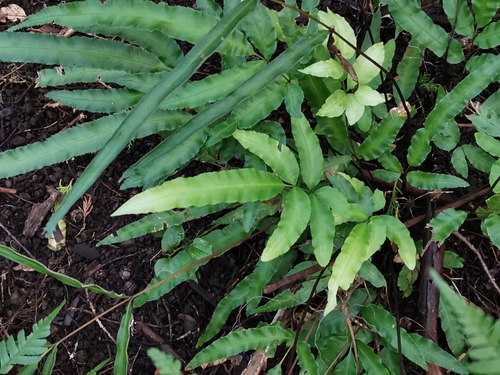
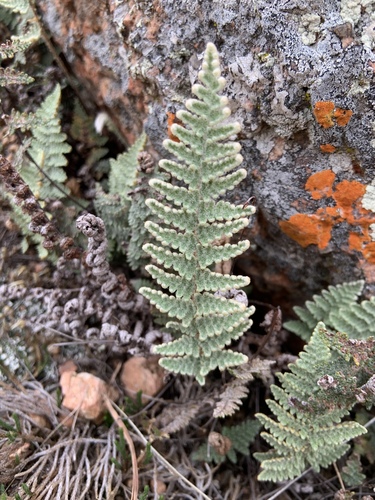
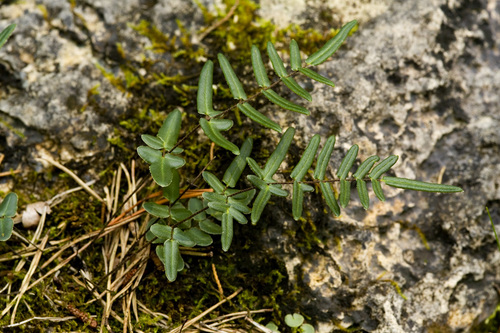
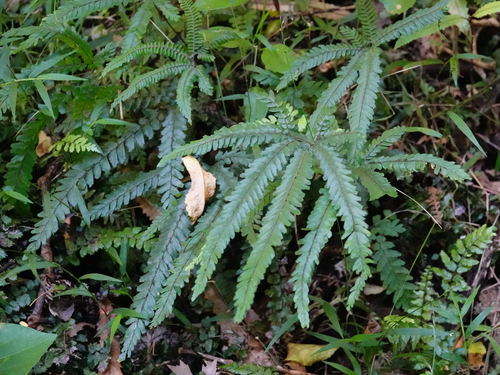
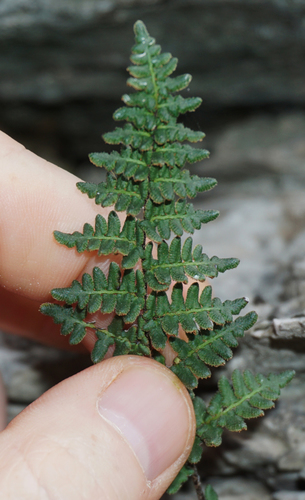
Myriopteris scabra grows from a short creeping rhizome that is usually 4–7 mm in diameter and covered with brown scales. Its fronds, or leaves, are clustered, and can vary widely in size from 5–30 cm long. The petiole of the leaf is black to dark brown. The leaf blade is 1–4 cm wide, shaped linear-oblong to lanceolate, and divided up to pinnate-pinnatifid to 2-pinnate. The rachis bears scattered linear-lanceolate scales and dimorphic pubescence: it is sparsely hirsute on the abaxial surface, and covered with tortuous appressed hairs on the adaxial surface. The ultimate leaflets are narrowly elliptic to elongate-deltate, not beadlike, and grow up to 3–5 mm long. The upper surface of the leaflets has a distinctive rough or spiky texture, which separates this species from most other Myriopteris, and is the origin of its specific epithet scabra, Latin for rough or coarse. Leaflet margins are only slightly folded under, barely concealing the sori when present; these sori form a continuous band around the margins of the leaflets. Myriopteris scabra is native to northern Mexico, the Yucatan Peninsula, and central and western Texas in the United States, with its range extending north into Oklahoma. It grows on rocks and in rock crevices, and is mostly restricted to limestone, found at elevations between 100 and 1400 meters. Several close relatives of Myriopteris scabra are also specialists of limestone or calcareous soil, including Myriopteris alabamensis, Myriopteris aemula, and Myriopteris microphylla. These related species have ranges across the southern United States, Mexico, and the Caribbean islands. Notably, another limestone-specializing Myriopteris species, Myriopteris gracilis, is not closely related to Myriopteris scabra. Myriopteris gracilis occurs across high mountains of the southwest United States, and ranges into much colder regions including Montana, Idaho, and British Columbia.