About Myriopteris lanosa (Michx.) Grusz & Windham
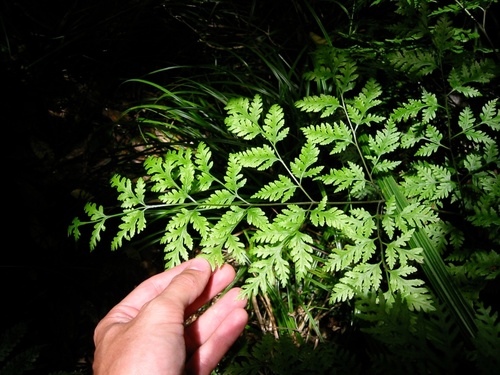
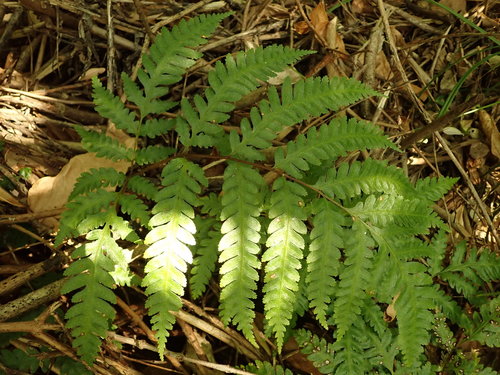
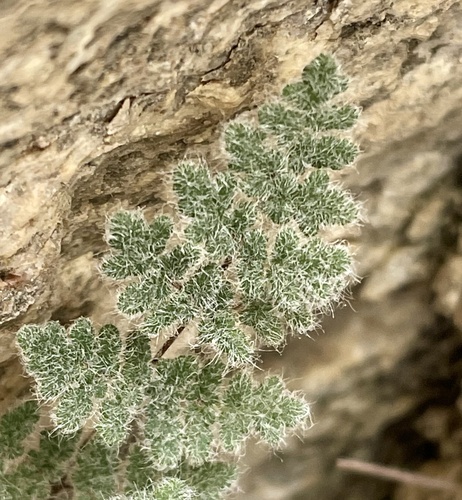
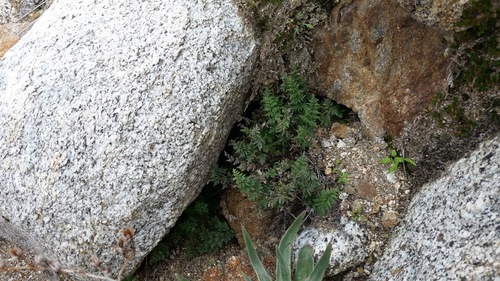
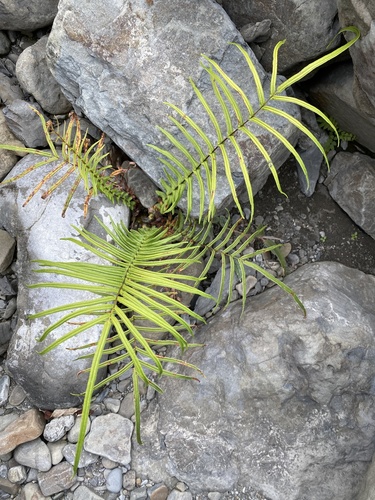
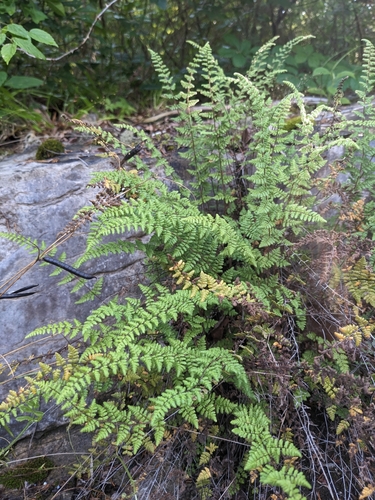
Myriopteris lanosa (Michx.) Grusz & Windham has leaf bases that are closely spaced along its rhizome. The rhizome is usually 4 to 8 millimeters (0.2 to 0.3 in) in diameter and rarely branched. It bears persistent scales that are linear to slightly lanceolate, distantly toothed, straight or slightly twisted, and loosely pressed against the rhizome surface. Most scales are brown, but at least a few have a thin, dark central stripe that does not contrast strongly with the rest of the scale. Fronds grow in clusters and emerge as fiddleheads, showing circinate vernation. When mature, fronds are 7 to 50 centimeters (2.8 to 19.7 in) long and 1.5 to 5 centimeters (0.59 to 1.97 in) wide. Fertile and sterile fronds look similar. The stipe, the stalk of the leaf below the blade, is 3 to 18 centimeters (1.2 to 7.1 in) long. It is dark brown to purplish-black, covered in many long, persistent, dark-jointed hairs, and has a rounded upper surface. Leaf blades range in shape from lanceolate to linear-oblong, and are typically bipinnate-pinnatifid, meaning they are cut into pinnae with lobed pinnules, at the base. Each blade has 12 to 20 pairs of pinnae. The rachis, or leaf axis, is rounded on the upper side, dark in color, and covered with uniform soft hairs, with no scales. Pinnae are not jointed at their base, and the dark pigment from the rachis extends into the edge of the pinnae. Pinnae at the base of the leaf are slightly smaller than the pinnae just above them, and pinnae are roughly symmetric around the costa, the pinna axis. The upper surfaces of pinnae are sparsely covered in hairs. The upper sides of the costae are brown for most of their length and do not have scales. Pinnules are lanceolate or oblong, and are not bead-shaped like those of some other Myriopteris species. Each pinna has 7 to 14 pairs of pinnules. The largest pinnules are 3 to 5 millimeters (0.12 to 0.20 in) long, with a sparse covering of long, segmented hairs on both the upper and lower surfaces. On fertile fronds, sori are protected by false indusia formed when the leaf edge curls back over the lower leaf surface. These false indusia are similar, though not identical, to other leaf tissue, and measure 0.05 to 0.25 mm wide. Under the false indusia, the sori are discontinuous rather than forming long lines, and concentrated on lobes at the tip and sides of the pinnule. Each sporangium in a sorus contains 64 spores. The diploid sporophyte has a chromosome number of 2n = 60. In terms of distribution and habitat, Myriopteris lanosa occurs in the Appalachian Mountains from Connecticut southwest to Alabama, north through middle Tennessee into the Shawnee Hills and west through the Ozarks. Outlying populations extend to Wisconsin, the Oklahoma Panhandle, Louisiana, and west Florida. A single specimen was collected by Edgar T. Wherry in Harrison, McLennan County, Texas in 1925. While the collection is believed to be authentic, the county has very little suitable habitat, and extensive sand and gravel quarrying make relocation of the population unlikely. This species grows in shallow soil on rocky slopes and ledges, and is not usually found on cliff faces, at altitudes between 100 and 800 meters (300 to 3,000 ft). It is not particularly specialized to any rock type, growing on limestone, granite, sandstone, and others. It can also grow in open woodlands and other open areas. In ecology and conservation, the species is globally secure (G5), but it is threatened in some states at the edge of its range. It is considered extinct in Delaware. NatureServe classifies it as critically imperiled (S1) in Connecticut, Louisiana, Mississippi, New Jersey, New York, Ohio and Texas, imperiled (S2) in Kansas, and vulnerable (S3) in Illinois and Indiana. For cultivation, this fern is easy to cultivate. It should be grown under medium-high light in well-drained, acidic soil, that is dry to slightly moist.