About Myriopteris covillei (Maxon) Á.Löve & D.Löve
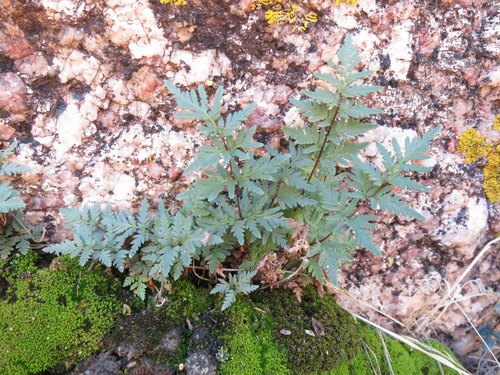
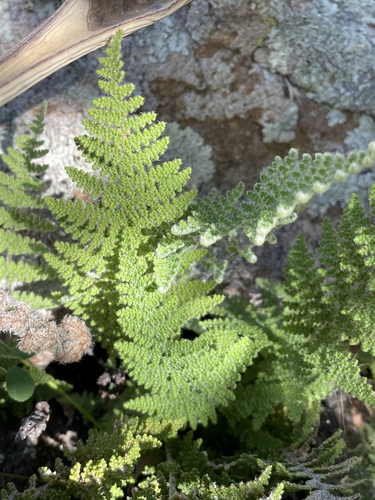
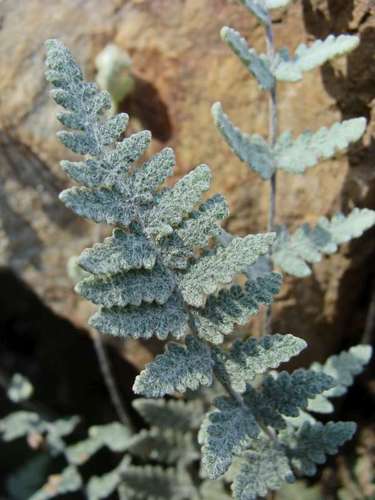
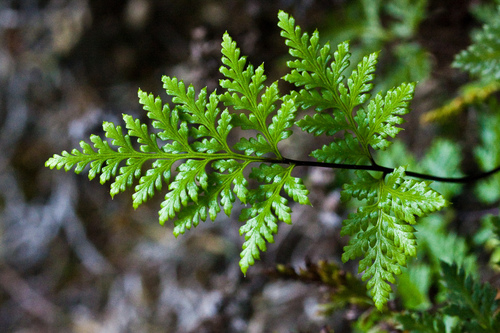
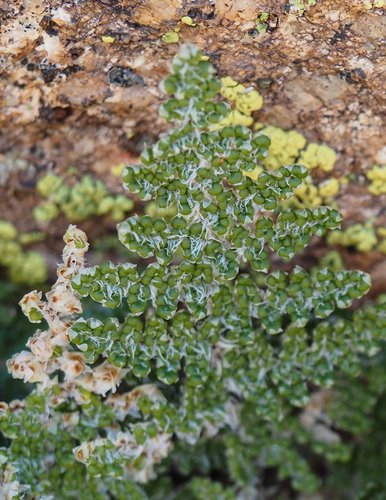
Myriopteris covillei (Maxon) Á.Löve & D.Löve has leaf bases closely spaced along its rhizome, which is usually 2 to 4 millimeters (0.08 to 0.2 inches) in diameter. The rhizome is covered with persistent scales around 2 millimeters (0.08 inches) long; these scales are linear to narrowly lanceolate, straight or slightly twisted, and tightly pressed (appressed) against the rhizome surface. They are uniformly dark brown to black, or occasionally have pale, narrow light brown margins, and do not have marginal teeth. Fronds grow in clusters and do not unfurl as fiddleheads, meaning they have noncircinate vernation. Mature fronds measure 5 to 30 centimeters (2.0 to 12 inches) long and 2 to 4 centimeters (0.8 to 2 inches) wide, occasionally reaching up to 6 centimeters (2 inches) wide. The stipe, the leaf stalk below the blade, is 3 to 16 centimeters (1.2 to 6.3 inches) long and less than 2 millimeters (0.08 inches) wide, rounded on its upper surface, and colored dark brown to dark reddish-brown or dark purple. It is covered in white to red-brown, lanceolate to linear scales up to 3 millimeters (0.1 inches) long, which may have cilia at their bases, if any cilia are present. Leaf blades are lanceolate to ovate-deltate in shape, typically 1.5 to 5 centimeters (0.59 to 2.0 inches) wide (or up to 6 centimeters/2 inches wide) and 3 to 17 centimeters (1.2 to 6.7 inches) long. At the base, blades are tripinnate to tetrapinnate, meaning they are divided into pinnae, pinnules, pinnulets, and sometimes further divisions of pinnulets. Leaf tissue is dark green. The rachis, or central leaf axis, is rounded rather than grooved on its upper surface, dark in color, bears some scales, and has no hairs. Blades usually grow around 10 pairs of pinnae, which are obtuse at the base and acute to acuminate at the apex. There is no distinct joint where pinnae attach to the rachis, and the dark color of the rachis extends into the base of the costa (the pinna axis). Each pinna is equilateral, and the lowest pair of pinnae is not noticeably larger than the other pairs. Apart from the dark base, the upper surface of the costae is green along most of their length. The lower surface of the costae is covered in prominent, ovate-lanceolate scales that are deeply cordate, or heart-shaped with a notch at the base. The largest of these scales are 0.4 to 1.5 millimeters (0.02 to 0.06 inches) wide, whitish with a chestnut-brown base. The scales overlap one another, and sometimes hide the final leaf subdivisions when viewed from below. Only the basal lobes of the scales have cilia. Lower layers of scales may be more highly dissected. The smallest leaf divisions are round or oblong, bead-like in shape, with the largest measuring 1 to 3 millimeters (0.04 to 0.1 inches) in diameter. A few small scales may be present at the base, but otherwise these bead-like segments have no scales or hairs on either surface. On fertile fronds, the leaf edge folds under to form a false indusium 0.05 to 0.25 mm wide. The tissue of these false indusia is only weakly different from the rest of the leaf blade tissue. Beneath the false indusia, the sori are more or less continuous around the margins of the bead-like segments. Each sporangium holds 64 tan or brown spores. Individual sporophytes have a diploid chromosome number of 2n = 60. M. covillei is very similar in appearance to its close relatives M. clevelandii and M. intertexta, and overlaps with their distributions in California and Baja California. It can be told apart by the characteristics of its costal scales: these are relatively broad, ciliated at most at the base, and the underside of the ultimate leaf segments has no scales or hairs. In M. clevelandii and M. intertexta, costal scales are narrower (less than 1 millimeter/0.04 inches wide) and ciliated along their entire lower portion, and both branched hairs and scales are present on the underside of leaf segments. Examining rhizome scales can also help with identification: M. covillei scales are dark brown and often uniformly colored (scales of the other two species usually have a lighter border), and are rigid and strongly appressed to the rhizome. By contrast, M. fendleri, which also grows in northwestern Mexico, has looser, deciduous rhizome scales. In terms of distribution and habitat, M. covillei ranges south from California into Baja California and Baja California Sur, with a disjunct population in southern Oregon, and extends east to Arizona, Nevada, and Utah. It grows in crevices, on top of ledges, and on rocky ground at the base of boulders. It tolerates both full sun and shade. It is more common on igneous rocks such as granite, but is also found growing with sandstone boulders. It occurs at altitudes between 100 and 2,500 meters (330 to 8,200 feet). For ecology and conservation status, while M. covillei is apparently globally secure (ranked G4), it is threatened in the northern part of its range. NatureServe classifies it as critically imperiled in Oregon, imperiled in Utah, and vulnerable in Nevada. For cultivation, Myriopteris covillei can be grown in cultivation, and should be planted under high light in well-drained garden soil. The growing medium should be dry to moist-dry.