About Myriopteris clevelandii (D.C.Eaton) Grusz & Windham
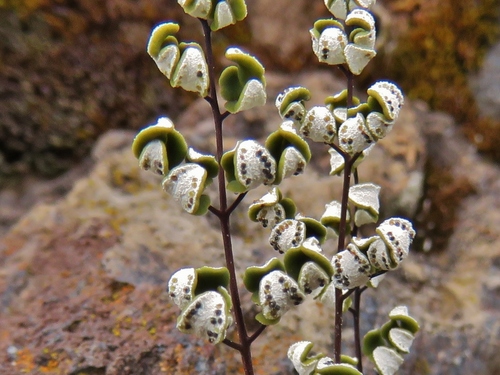
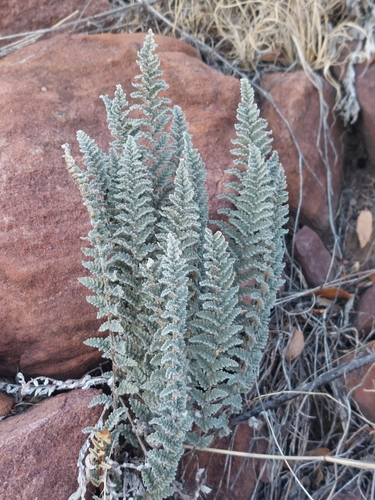
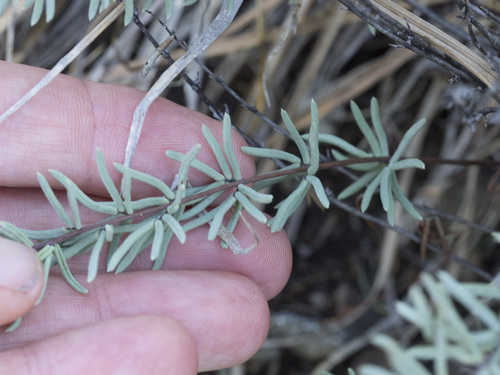
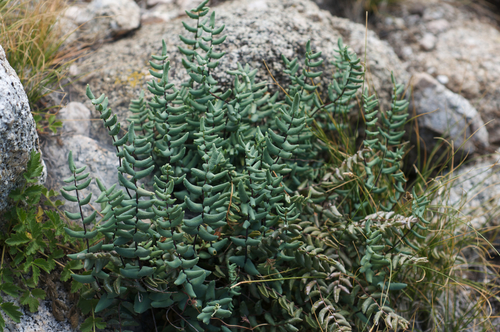
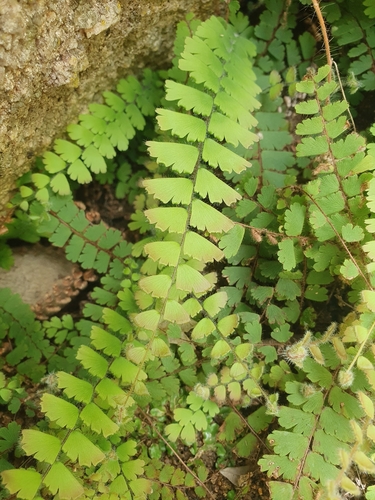
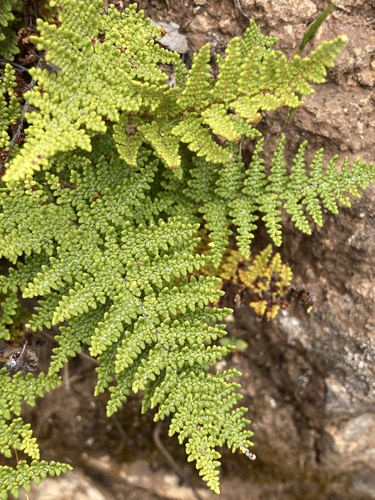
Myriopteris clevelandii has horizontal rhizomes 1 to 3 millimeters (0.04 to 0.1 inches) in diameter, with leaves that are either closely or broadly spaced along the rhizome. The rhizome bears persistent, straight or slightly twisted, strongly appressed linear-lanceolate scales that are shiny, and range in color from dark brown, brown to red-brown. These scales may be uniformly brown, or have a dark central stripe with paler edges. Their margins are either entire, or erose to slightly toothed with widely spaced teeth. Fronds grow from the rhizome either in clusters or as somewhat scattered individual leaves. Unlike many ferns, this species does not produce new fronds as coiled fiddleheads, a trait called noncircinate vernation. Mature fronds measure 8 to 40 centimeters (3 to 20 inches) long. The stipe, the leaf stalk below the blade, makes up about half of the total frond length, and measures 5 to 31 centimeters (2.0 to 12 inches) long. The stipe is shiny, rounded, and dark to light brown; it is covered in 1-to-2-millimeter (0.04 to 0.08 inch)-long hairs and threadlike (filiform) gray to red-brown scales, which are lost as the frond ages. It is typically less than 2 millimeters (0.08 inches) wide, and may grow up to 3 millimeters (0.1 inch) wide. Leaf blades are oblong-lanceolate to ovate, and tetrapinnate (divided into pinnae, pinnules, pinnulets, and pinnulet divisions) at the base. They usually measure 6 to 23 centimeters (2.4 to 9.1 inches) long and 2 to 8 centimeters (0.8 to 3 inches) broad. The rachis, the central leaf axis, is rounded on its upper surface rather than grooved, with no distinct joint where pinnae attach to the rachis; the dark color of the rachis extends into the base of the costa, the pinna axis. Mexican specimens have 10 to 12 pairs of pinnae, while some Californian material has somewhat more. Each pinna is equilateral in shape, and the lowest pair of pinnae is not significantly larger than the other pairs. The upper surface of the costae is green along most of their length. The lower surface of the costae is covered in conspicuous broad scales that are ovate-lanceolate to broadly deltate in shape, deeply cordate (notched at the base to appear heart-shaped), and around 1 millimeter (0.04 inches) long and 0.4 to 1 millimeter (0.02 to 0.04 inches) wide. These scales overlap, and sometimes hide the final leaf subdivisions from below. Scales closer to the base of the costa are ciliate. The smallest leaf divisions are round or slightly heart-shaped, beadlike in appearance, no more than 1 to 2 millimeters (0.04 to 0.08 inches) across, and concave on the lower surface. The upper surface of the leaf is glabrous, meaning it has no hairs. The lower surface of the leaf is covered in ciliate scales, similar to those on the costa but narrower, sometimes appearing like branched hairs, and more or less conceals the leaf surface. On fertile fronds, sori are protected by false indusia formed by the leaf edge curling strongly back over the underside, often hiding the sori. The recurved edges are only slightly modified compared to the rest of the leaf tissue; they are 0.05 to 0.25 mm wide with entire margins. The sori contain brown spores, with 64 spores in each sporangium. Larger specimens with more dissected scales from some of the northern Channel Islands have been called "var. clokeyi", but this name has never been formally published. M. clevelandii is very similar to M. covillei, a species usually found further inland. M. covillei lacks the reduced, hairlike scales on the abaxial (lower) leaf surface, has larger scales on the abaxial surface of the costa, and those scales only have cilia on their basal lobes. This fern is native to southern California, specifically the Peninsular Ranges and several of the northern Channel Islands, as well as northern Baja California, Mexico. It grows in a variety of rocky, exposed habitats including chaparral, on slopes and ledges, at the bases of boulders, and in crevices. It usually prefers igneous rocks, and occurs at elevations from 0 to 1,600 meters (0.0 to 5,200 feet). NatureServe classifies Myriopteris clevelandii as globally vulnerable (G3). It faces few distinct threats, but its natural range is limited.