About Myriopteris alabamensis (Buckley) Grusz & Windham
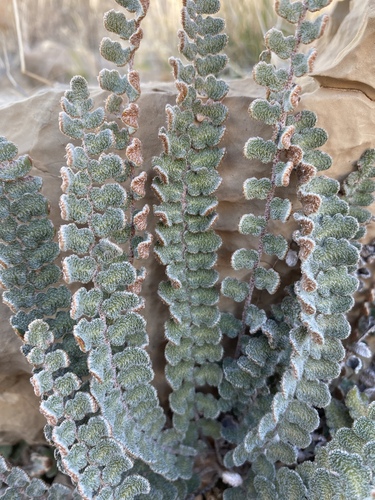
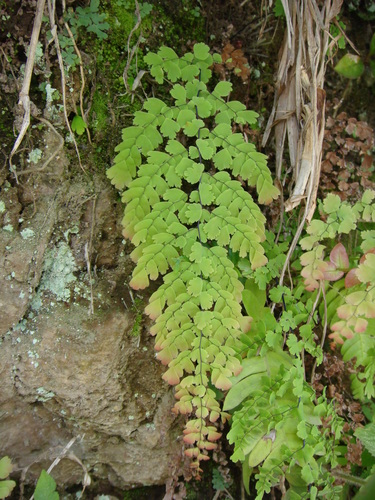
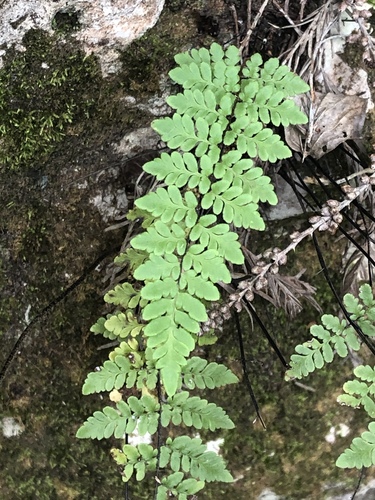
The scientific name of this fern is Myriopteris alabamensis (Buckley) Grusz & Windham. Leaf bases are closely spaced along the rhizome, which has been variously recorded as 1 to 2 millimeters (0.04 to 0.08 in) or 3 to 7 millimeters (0.1 to 0.3 in) in diameter. The rhizome bears persistent scales that are linear to narrowly lanceolate, distantly toothed, straight or slightly twisted, and loosely appressed (pressed against the surface of the rhizome). Scales may be uniformly brown or orange-brown, or have a brown central stripe at the base that fades to pale orange-brown across the rest of the scale. Fronds grow in clusters, and do not unfold as fiddleheads, meaning they have noncircinate vernation. Mature fronds are 6 to 50 centimeters (2.4 to 20 in) long and 1 to 7 centimeters (0.4 to 3 in) wide. The stipe, the stalk of the leaf below the blade, is 3 to 23 centimeters (1.2 to 9.1 in) long. It is black, covered in long, straight, matted whitish or yellowish hairs, and has a rounded upper surface. Leaf blades range in shape from lanceolate to linear-oblong. Blades are usually bipinnate (cut into pinnae and pinnules) to bipinnate-pinnatifid (cut into pinnae and lobed pinnules) at the base. The rachis, or leaf axis, is rounded on the upper side and dark in color. It has twisted hairs tightly pressed to its upper side, and scattered, spreading, straight hairs on its lower side; no scales are present. Pinnae are not jointed at the base, and the dark pigmentation of the rachis extends into the edge of the pinnae. The pinnae at the base of the leaf are slightly smaller than the pinnae immediately above them, and pinnae are more or less symmetric around the costa (pinna axis). The upper surfaces of the pinnae have a few soft hairs, or no hairs at all. The upper sides of the costae are green for most of their length, and lack scales beneath. Pinnules are elliptical to long-triangular, and are not bead-shaped like pinnules of some other Myriopteris species. The largest pinnules are 3 to 7 millimeters (0.12 to 0.28 in) long, and have sparse white hairs on their upper and lower surfaces, or lack hairs entirely. On fertile fronds, sori are protected by false indusia formed by the leaf edge curling back over the underside. The false indusia are somewhat differentiated in appearance and texture from the rest of the leaf tissue, and are 0.1 to 0.4 mm wide. Beneath the false indusia, sori are generally continuous around the edges of fertile pinnules. Each sporangium in a sorus holds 32 spores. Most individual sporophytes are apogamous triploids, with a chromosome number of 3n = 87. Sexual diploids with 2n = 58 have been recorded from Nuevo Leon, Mexico. Within the United States, M. alabamensis occurs in the southern Appalachian Mountains from Virginia and North Carolina southward, in the Ozarks, along the southern border of Arizona, New Mexico and Texas, and in a few isolated stations in the Mississippi Valley and on the east coast of Florida. In Mexico, it is found in the northern states bordering the United States (excluding Baja California) and extends south through central Mexico to Oaxaca. Myriopteris alabamensis typically grows on limestone cliffs and ledges, or on the ground on shell mounds or among limestone rocks. It prefers shady habitat, and has been recorded at altitudes from 100 to 2,400 meters (330 to 7,900 ft). Myriopteris alabamensis can be cultivated, and should be grown under medium-high light in alkaline garden soil mixed with sand. The growing medium should be dry to slightly moist.