About Myosotis verna Nutt.
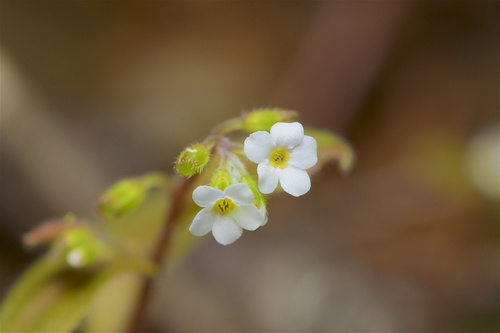
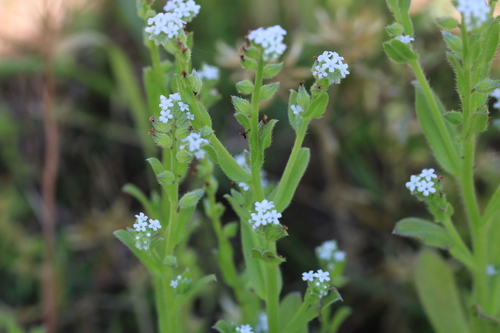
Myosotis verna Nutt. is a low-growing herbaceous plant that grows up to 40 cm tall. Its leaves are alternate, simple, and lanceolate, with each leaf featuring a prominent central vein. The lowest leaves of this species wither by the time it begins to flower. Stems are either round or angled in cross-section; they may grow as multiple stems branched at the base, or a single erect stem, with few branches higher up. Stems are densely covered in fine, bristly hairs. The flowers are inconspicuous, five-petaled, and typically white, growing at the ends of stems. The calyx that surrounds the base of each flower is approximately 6 mm long, twice as long as the flower stalk. It has five lance-shaped lobes, three of which are longer than the other two, and all lobes are shorter than the calyx tube. The floral tube is shorter than the calyx, which means the flower retains a bell shape even when fully open. The calyx is thickly covered in spreading hairs, and hairs on the lower part of the calyx may have hooked tips. The egg-shaped nutlets grow in clusters of four; they are shiny, usually black, and measure between 1.2 and 1.5 mm long, and 1.1 and 1.2 mm wide. This plant grows well in both anthropogenic habitats including railways, roadsides, and disturbed land, and natural habitats including woodlands, dry scrubland, ledges, and bluffs. It flowers from April to June, and produces fruit shortly after flowering finishes. Myosotis verna is most closely similar to Myosotis macrosperma, but differs in that its fruit stalks are diverging and more widely spaced, and its nutlets are usually somewhat larger. It is also similar to Myosotis stricta and Myosotis discolor; these two species differ from Myosotis verna by having blue flowers.