About Myosotis sylvatica Ehrh. ex Hoffm.
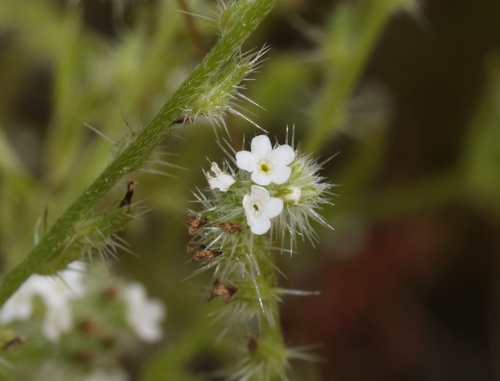
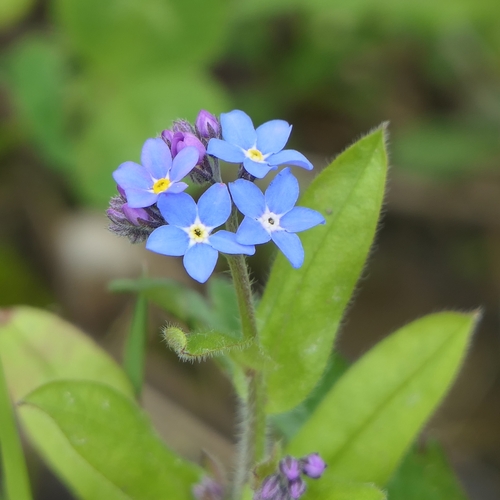
Myosotis sylvatica Ehrh. ex Hoffm. is a short-lived herbaceous perennial plant. It grows 12–30 cm (5–12 in) tall and 15 cm (6 in) wide, with hairy leaves and an abundant display of flowers. Its flower petals are longer than their tube; buds are pink, and open flowers are disc-shaped, intensely sky-blue with yellow centres, blooming in spring. Stace (2011) documents additional characteristics for this species: it is an upright plant that can reach up to 50 cm tall, it is covered in soft hairs that grow more-or-less at right angles to the main stem. Flowers are sky-blue, up to 6–10 mm across and flat in profile, the sepal tube has hooked hairs, and flowering occurs from April to July. Mature fruit is dark brown and shiny. The mature calyx sits on spreading stalks longer than the sepal tube, and calyx teeth spread open to expose the ripe fruit. Basal leaves are stalked and arranged in a rosette, while upper leaves are unstalked. This species is generally found growing in woods, scree, and rock ledges, and it is common throughout the British Isles.
It is widely cultivated across the temperate world, and is particularly used in spring bedding schemes alongside other spring-flowering plants, most notably daffodils, tulips, wallflowers, and primulas. Typically, seeds are sown one year to produce flowers the following year. Although it is short-lived, plants self-seed readily in favourable conditions. Plants retain leaf growth throughout the winter. Myosotis sylvatica is also a parent of numerous cultivars that produce flowers in shades of pink, blue, and white. The cultivars 'Bluesylva' and the compact 'Blue Ball' have earned the Royal Horticultural Society's Award of Garden Merit. Other registered cultivars include: 'Blue Basket', a taller variety with deeper blue flowers; 'Music', an erect variety with large flowers; 'Pompadour', a compact, ball-shaped variety with large rose-pink flowers; 'Snowball', which produces white flowers; 'Ultramarine', a dwarf variety with very deep blue flowers; and 'Victoria Rose', which produces bright pink flowers.