About Myosotis pulvinaris Hook.fil.
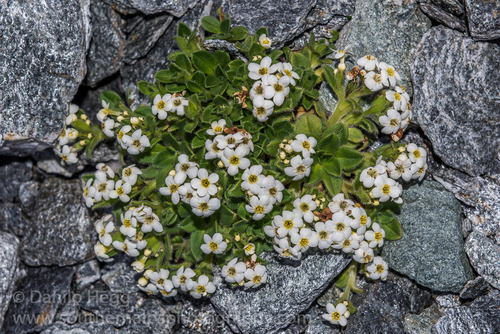
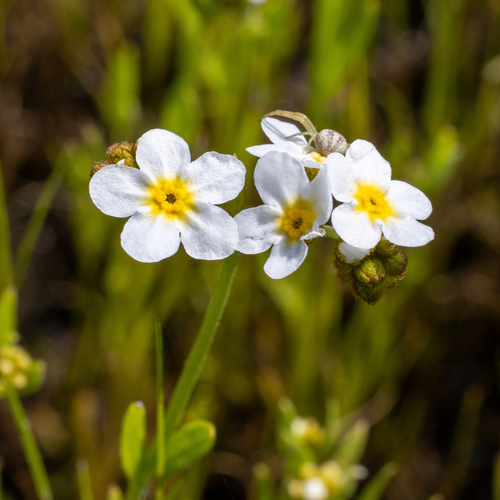
Plants of Myosotis pulvinaris Hook.fil. grow as tightly compacted cushions that can reach up to 50 cm in diameter. The species produces numerous imbricate rosette leaves, with glabrous petioles that measure 1–7 mm long. Rosette leaf blades are 1–6 mm long by 2–6 mm wide, with a length to width ratio of 0.7–1.5:1. Blades range from broadly ovate to very broadly ovate, obovate to very broadly obovate, round, or orbicular, are widest at or above the middle, and have an obtuse apex. Both the upper and lower leaf surfaces are densely covered in long, flexuous, mostly appressed antrorse (forward-facing) hairs that are oriented parallel to the mid vein, while the leaf margin has hairs that range from patent to erect. Each rosette produces few prostrate to ascending, once-branched, bracteate inflorescences that grow up to 70 mm long. Cauline leaves are similar in shape to rosette leaves but smaller, decreasing in size toward the tip of the inflorescence. Each inflorescence holds a single solitary flower, which is borne on a short pedicel and accompanied by a bract. The calyx is 3–5 mm long during flowering and 4–6 mm long during fruiting, is lobed to between one-third and one-half of its total length, and is densely covered in long, antrorse, flexuous, appressed hairs. The corolla is white, up to 10 mm in diameter, with a cylindrical tube, flat petals that range from narrowly to very broadly obovate or ovate to very broadly ovate, and small yellow scales that alternate with the petals. The anthers are partly exserted, with only their tips surpassing the scales. The four smooth, shiny, dark brown nutlets are 1.3–2.1 mm long by 0.7–1.0 mm wide, and are narrowly ovoid to ovoid in shape. The chromosome number of M. pulvinaris is unknown, and this species has pollen of the M. uniflora type. Flowering and fruiting occur from October to April, with the main flowering period falling between December and February, and the main fruiting period between January and March. Myosotis pulvinaris is a forget-me-not endemic to the mountains of the South Island of New Zealand. It occurs mainly in Otago, but has also been recorded from Westland, Canterbury and Fiordland, at elevations from 1020–2130 m above sea level. In these areas, M. pulvinaris is common and locally abundant in subalpine to alpine fellfields and cushionfields.