About Myosotis lyallii Hook.fil.
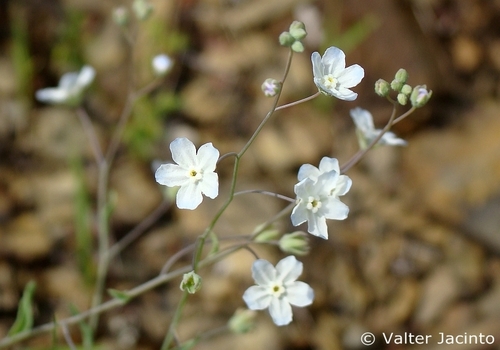
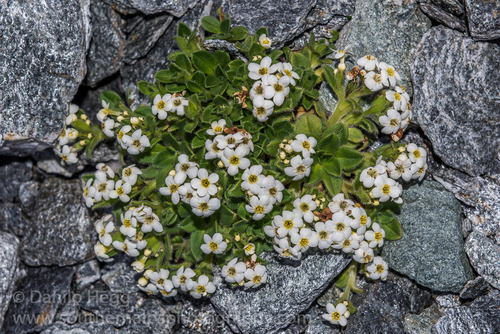
Myosotis lyallii Hook.fil. plants grow as rosettes that cluster together to form loose clumps. Rosette leaves typically have petioles 1–18 mm long, and rarely reach up to 40 mm long. Rosette leaf blades measure 3–27 mm long by 2–13 mm wide, with a length to width ratio of 1.1–3.6:1. They are usually narrowly obovate to broadly obovate, most often widest at or above the middle, and usually have an obtuse apex. The upper leaf surface is densely covered in long, flexuous, sometimes curved, usually patent, antrorse (forward-facing) hairs that lie parallel to the mid vein. The leaf margin and petiole margin have patent to erect hairs. The lower leaf surface has a similar hair covering, except it may be glabrous, or only have isolated hairs on the midrib. Each rosette produces 1–19 prostrate or ascending inflorescences, which are unbranched or once-branched, bracteate or partially-bracteate, and grow up to 105 mm long, rarely reaching 230 mm long. Cauline leaves, sometimes called bracts, are similar in shape to rosette leaves but smaller; they decrease in size and become sessile toward the inflorescence tip. Each inflorescence holds 2–15 flowers, each born on a short pedicel, and each usually accompanied by a bract. The calyx measures 3–7 mm long at flowering and 4–8 mm long at fruiting, and is lobed to one-third to two-thirds of its total length. It is densely covered in long, antrorse, mostly flexuous, appressed to patent hairs; the calyx base is sometimes mixed with retrorse (backward-facing) hairs, or curved, rarely hooked, hairs. The corolla is white, up to 11 mm in diameter, with a cylindrical tube, flat petals that are broadly to very broadly ovate, or obovate to very broadly obovate, and small yellow scales that alternate with the petals. Anthers are either fully exserted or partially exserted, with only the tips or upper third extending past the scales. The four smooth, shiny nutlets can be light, medium, or dark brown; they measure 1.1–2.4 mm long by 0.6–1.5 mm wide and are narrowly ovoid to ovoid in shape. The chromosome number of Myosotis lyallii is unknown, and it has pollen of the Myosotis australis type. Flowering and fruiting occur from November to April. Myosotis lyallii is a forget-me-not endemic to the mountains of New Zealand, occurring at 900–2200 m above sea level. It is found across the entire South Island, including the ecological districts of Western Nelson, Marlborough, Westland, Canterbury, Otago, Southland and Fiordland. There are also recorded occurrences in the North Island, in the Southern North Island ecological province. It grows in subalpine to alpine habitats, including grasslands, fellfields and herbfields.